Recently, a lot of self-assembled ordered molecular networks formed by organic molecules coupled by highly directional H-bonds have been found [1]. Porous molecular network of anthraquinone (AQ) [2] is one of the most beautiful examples of such orderings (fig 1.). The network originates from a delicate balance between substrate-mediated repulsion and intermolecular attraction involving H-bond coupling of neighboring molecules. Hexagon sides consist of three parallel anthraquinone molecules, while hexagon vertices are formed of three molecules in pin-wheel arrangement. As a result, honeycomb network with huge molecular pores (~50Å) occurs.
We propose the statistical model for anthraquinone ordering into such porous network. This model considers short-range (caused by H-bonds) and long-range (caused by dipole-dipole forces) interactions between molecules. It also accounts for the elongated form of the molecule for short range interactions. There are two short-range interactions which differ by their chemical bonding: interaction of two nearest neighbor (NN) molecules which are arranged in parallel ("side-by-side") corresponding to double H-bonding of two AQ molecules, and NN "side-by-head" interaction corresponding to one H-bonding. Our model takes into account these attractive pair interactions together with short-range pin-wheel triangular trio interaction (three molecules interconnected by "side-by-head"-type H-bonds). In addition, the model considers some long-range surface-mediated interactions: repulsive dipole-dipole and Friedel-type oscillatory [3] interactions. To mimic the oscillatory behavior of these interactions, long-range attractions at the distances corresponding to the honeycomb pore diameter were considered and were shown to be crucial to obtain porous honeycomb structure.
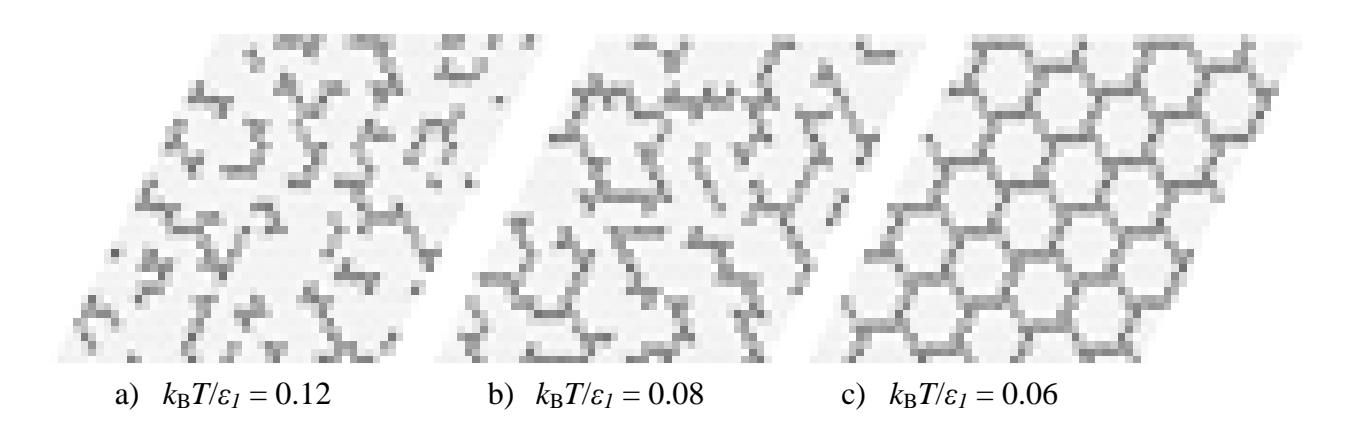
During MC simulations the experimentally observed porous structure was obtained (fig. 1), and the set of interaction parameters required to obtain this phase was determined. In addition, the ordered systems with analogous pin-wheels, but different hexagon side length were observed at different set of interactions.