
In this work spectra of excitation and spectra of fluorescence of thin films with different number of monolayers were obtained. Quartz was used as a substrate. The purpose of this work is to reveal low dimensional effects that rise in Langmuir-Blodgett films (LB-films) using spectroscopic methods. Iron-doped LB-films of ditienilepyrrole were used.
To obtain spectra of excitation and spectra of fluorescence, the spectorfluorometer Solar 1211A was used. 150 watt high pressure xenon arc lamp was used as the light source. It gives almost continuous spectrum except several narrow lines near 470 nm, 660 nm and 800-1000 nm. [1]
The technique of experiment included the preliminary calibration of the device. The calibration consists in obtaining of fluorescence and excitation spectra of the quartz substrate without LB-films. These spectra were needed to subtract them from final ones. Then the spectra of excitation of samples with LB-films were measured with registration at wavelengths of 400 nm and 460 nm. Consequently the samples are excited on the wavelength corresponding to the maximum of the spectra of excitation. Then the maximum of the fluorescence spectrum was determined, and the excitation spectrum of samples was measured again. This procedure should be repeatedly done until the wavelength of registration would be in a correspondence with the wavelength of the maximum of the fluorescence spectrum, and, oppositely, the wavelength of excitation would be in a correspondence with the wavelength of the maximum of the excitation spectrum.
The obtained spectra of fluorescence are shown at Fig.1. The wavelength of excitation is 219 nm. On the graph one can observe the maximums of fluorescence spectra at the wavelength of 296 nm for the 3-layered film, 302 nm for the 5-layered film, 303 nm for the 7-layered film. For the 9-layered film the maximum at this wavelength is not observed.
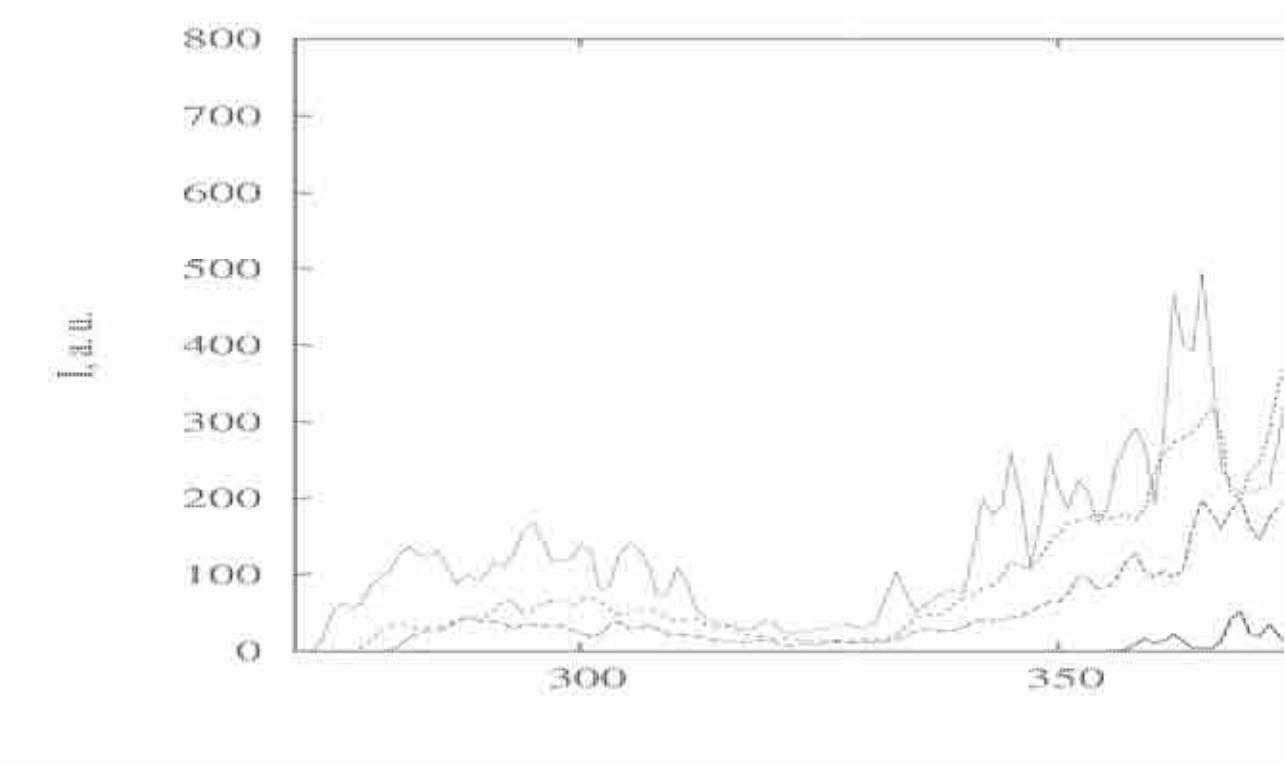
This phenomenon can be explained as follows. In the films which consist of 9 and more monolayers medium can not be treated as a low-dimensional sample, and conventional zone theory is to be applied. This is due to the fact that interactions between layers become considerable. So the thin films lose their special properties, including appropriate scattering phenomena that were observed for samples with 3, 5 and 7 layers.