
Fiber lasers mode-locked by semiconductor saturable absorber mirror (SESAM) are unsurpassed in terms of the beam quality, compactness and easy integration. Different techniques are known for subsequent power and energy scaling. In particular, crystal fiber amplifiers benefit from the good overlap between pump and seed beams due to the pump guiding and improved thermal management ensured by the high surface-to-volume ratio [1].
We present results of numerical and experimental investigation of thermally induced beam distortions for Nd:YAG crystal fiber amplifier injected by 5 ps pulses with beam quality factor of M2~1.1. These seed pulses were emitted from passively mode locked fiber laser running at repetition rate of 29 MHz with average output power of 1.6 mW at wavelength of 1064.14 nm. Single-pass amplifier is end-pumped at 808 nm wavelength by fiber coupled laser diode with Bragg grating (Fig.1 – upper-left). Collimated seed of ~0.5 mm diameter counter-propagates through Nd:YAG rod of 1 mm diameter and 50 mm length doped by 0.2% Nd.
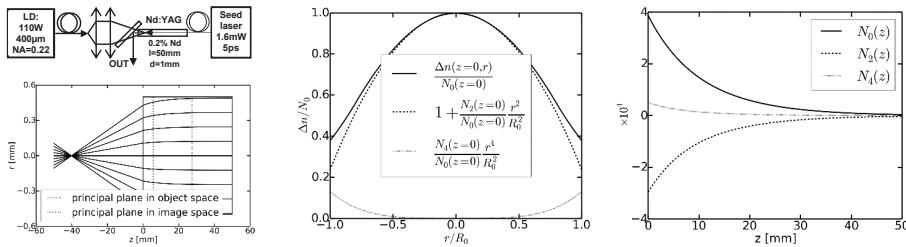
Continuous pumping and high repetition rate of seed pulses permits to investigate the steady state case [2]. It is recently shown [3] that the commonly used plane stress or plane strain approximations significantly overestimate the values of face bulging of laser rods under the condition of longitudinal pumping. It is particularly true for long rods when only radial heat flow can be treated. The dependence on the longitudinal coordinate arises due to the heat source. The analytical solutions can be found for different distributions of pump beam taking into account the temperature dependence of thermal conductivity [2]. In this case the temperature change is not parabolic in the region of pump beam even for the top-hat pump beam distribution. It should be noted that one more cause for the occurrence of thermal aberrations is the nonlinear dependence of thermal refractive index change [2]. Thus, in the cylindrically symmetric case it can be presented as $\Delta n_T(r,z) = N_0(z) + N_2(z)(r/R)^2 + N_4(z)(r/R)^4$ where coefficients Nj(z) are found numerically by fitting procedure and R0 = 0.5 mm is the radius of the rod (Fig. 1 - right). Two r-dependent terms are sufficient for the precise fitting of refractive index change (Fig.1 – center). Then, using the methods of matrix optics, the ABCD-matrix of thick lens with inhomogeneous refractive index distribution was found and ray tracing procedure was performed (Fig. 1 - bottom-left). The focal length of thermal lens (fT =46.9 mm) found during this procedure is slightly longer ($\hat{f}_T$ =43 mm) than the one found from the optical path difference $OPD(r) = r^2/2 \hat{f}_T - l \overline{N}_4 (r/R)^4$. The latter procedure corresponds to averaging of $\Delta n_T(r,z)$ along the rod: $\overline{N}_j = (1/l)\int_0^l N_j(z)dz$. The difference between these approaches is more significant in defining the positions of principal planes defined with respect to the entrance and exit planes of pump beam: the matrix method gives den = 5.7 mm and dex = 22.5 mm (Fig. 1 – bottom-left) instead of $\overline{d}_{en} = \overline{d}_{ex} = 13.9$ mm. The change of near Gaussian seed beam quality to M2 = 1.14 was found using formulae from [4]. For all other pump beam intensity distributions and amplification saturation the M2 of the seed beam should increase.
Therefore, amplified beam quality degradation is conditioned mainly by thermally induced spherical aberrations. Nevertheless, high quality amplified output beams with M2 ~1.24-1.3 have been achieved from the Nd:YAG crystal fiber amplifier module pumped by 100-110 W with gain in excess of 50 and output power over 80 mW.