
The sandy beaches of the Baltic Sea along the mainland coast of Lithuania are mainly composed of quartz sands. Heavy minerals are locally important accessory components. Heavy-mineral concentrations (HMCs) in coastal sands serve as important indicators of hydrometeorological and sedimentological conditions [1], [2].
To examine the patterns in HMC distribution, a total of 221 surface sand samples were collected from the middle of the beach, foredune toe, and stoss slope at 500 m intervals along the mainland coast from the northern part of the Port of Klaipėda to Lithuania–Latvia border. To characterize the relative concentrations of heavy minerals, a Bartington MS3 field scanning sensor was used for rapid and effective measurements of low-field volume magnetic susceptibility (MS). Along the Baltic Sea beach, in-situ MS values of ${\kappa}$<50 µSI of background quartz-rich sands contrast with ${\kappa}$>150 µSI in surface HMCs.
The highest value of MS was found near cliffs, where mean grain size reach 0.5 mm. Heavy mineral concentration depends on grain size [3]. As the distance of the cliff increase, mean grain size and MS value is going to decrease (Fig. 1). The highest MS values were found in the middle of the beach, the lowest – on the slope.
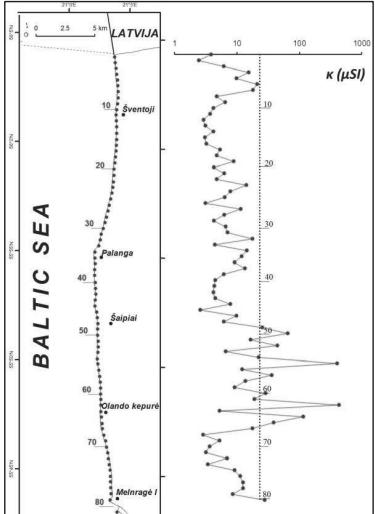
At cross-section of the coast with foredune maximum average MS values are on foredune toe and less on the middle of the beach and stoss slope.
The main factor that controls heavy mineral concentration grading longshore and cross-shore the coast is the source area of the sediments, erosional and/or accretional beach processes and human activity.