
Water pollution due to organic compounds is a serious problem because of toxicities and carcinogenic nature of the pollutants. Adsorption on carbon is inexpensive, universal and easy operational method to remove organic pollutants from water. The goal of this project is to investigate the effect of activated carbon (AC) of adsorption phenomenon of organic pollutants and evaluate adsorption constants.Three main classes of organic pollutants were used for experiments: easily biodegradable (acetate), slowly biodegradable (metoprolol) and non-biodegradable organic matter (BTEX – benzene, toluene, ethyl benzene and xylenes).
The batches tests were used to estimate Freundlich and Langmuir isotherms constants [1] for target compounds adsorption on AC. Tests were carried out with a whole group of BTEX and each compound separately to evaluate the influence of other compounds. The adequate tests and calculations were performed with metoprolol, acetate and bisolute (metoprolol and acetate mixture).
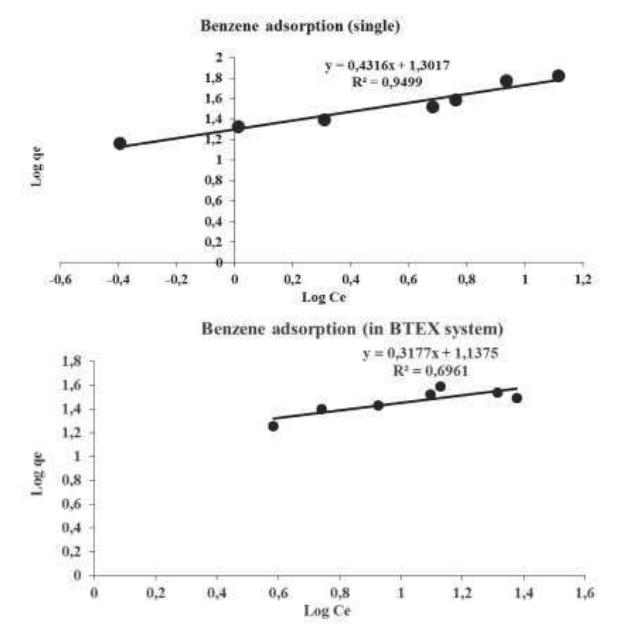
The results shows that in the case of BTEX Freundlich isotherm model for adsorptive capacity of AC is more reliable than Langmuir model because of variability of Langmuir constants. However, both models confirm that BTEX compounds are better adsorbed in the case of single solution (Fig. 1). In the case of metoprolol and acetate, adsorption capacity of AC in bisolute is 23% less than in single solute according to metoprolol adsorption in Freundlich model. The calculated constans also shows the lowest adsorption capacity of AC on acetate than metoprolol.
The present study offers data which can be used for the modeling of biological activated carbon systems to treat pharmaceuticals (metoprolol) or aromatic compounds (BTEX).