
Information-centric networks (ICN) are overlay networks, where content is found not by the traditional addressing, but by the naming of the content. It forms a new approach of identification, addressing and caching of such content in the network. It is important how to search and transfer the content, but not how to connect clients to the network. When planning information-centric networks these three main questions occur: 1) the design of the new architecture of the network, 2) the distribution and caching of content in the network, 3) the mechanisms of request routing.
The main scope of this work was to construct the ICN with different caching properties and to investigate how the caches are used.
When designing placement of caches the main focus was the mechanism of request routing. There are two main routing and caching strategies in this setting: on-path and off-path. According to the on-path strategy, contents are cached as they travel through the network by any on-path cache or a subset of traversed caches [1]. Content requests are forwarded towards the content source, but are stopped at the first cache. When using the off-path strategy, content placement and request-to-cache routing operate according to predefined rules that assign contents to the caches. It could be implemented by hash-routing.
In this work, an information-centric network based on LITNET network topology and parameters was generated. Icarus program [2] was used to simulate this ICN. Five different routing schemes of off-path strategy and tree – on-path schemes were investigated in three different network scenarios to analyze hash-routing schemes in information-centric networks and compare the results of on-path to off-path strategies. Two main attributes were varied in the study: cache to content population ratio (C) (size of the network caches) and content popularity distribution skewness ($\alpha$) (represented by the Zipf parameter). The impact of these variables on the cache-hit-ratio (number of requests for content, which reached the caches) and on the average link load (Fig. 1) was analyzed.
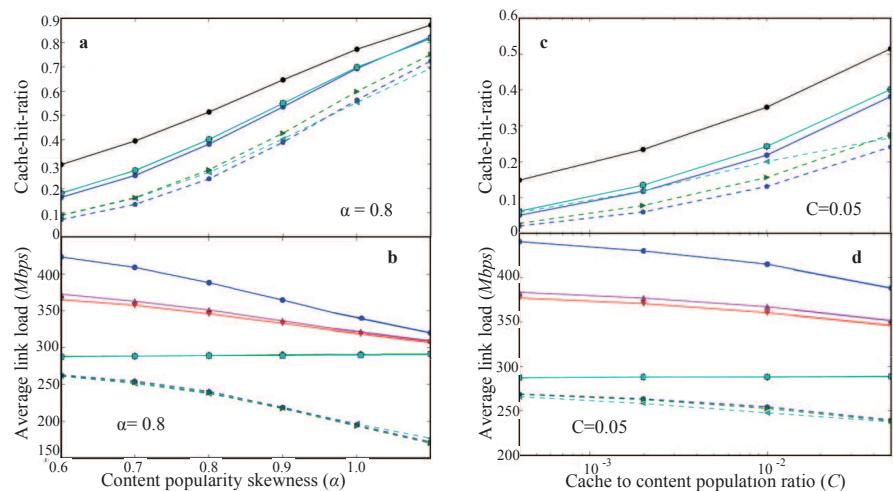
The results (a, c) show that off-path routing schemes reach higher cache-hit-ratio than reached using on-path routing schemes. It means that using hash-routing schemes the caches were used more efficiently. However, the results (b, d) illustrate that the network load increases when using hash-routing schemes.