
Advantages of non-destructive and non-ionizing terahertz (THz) waves applications for security and imaging [1] remains the main stimulus to develop compact and sensitive THz imaging systems which would operate at room temperature. This work is dedicated for THz source based on frequency multiplying chain analysis and usage in imaging systems.
The "Virginia Diodes" terahertz source was analyzed by measuring emitted power and beam profile at 180-210 GHz, 285-313 GHz and 555-630 GHz frequency ranges and at separate distances from THz source. Power of terahertz source was measured using Thomas Keating power meter, signal generator modulation frequency was 33 Hz. Beam profiles of the source were imaged at 3-12 cm distance from antenna with no additional optical components. Spatial resolution was set of 0.3 mm in y-direction, and 0.1 mm in x-direction. Shape of the emitted beam was measured close to Gaussian with small side lobes at 180-210 GHz, 285-313 GHz and 555-630 GHz frequencies.
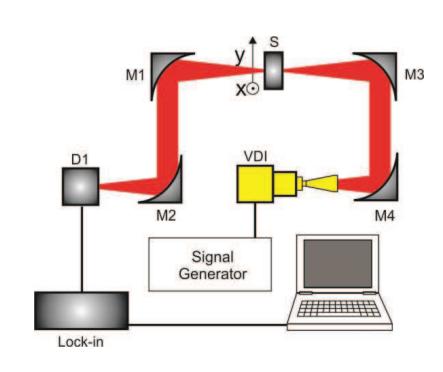
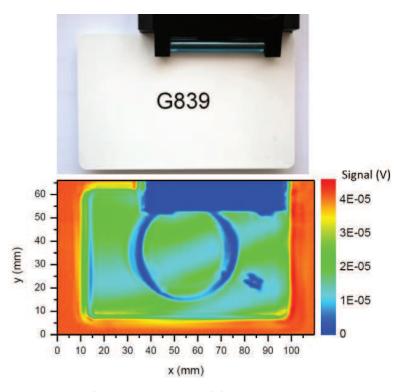
Set-up of terahertz imaging system in transmission geometry is shown in Fig. 1. The signal was detected with the "bow-tie" diode [2]. The smart cards and Radio-frequency identification (RFID) cards were imaged. Signal generator modulation frequency was set to 2 kHz, positioning stage spatial resolution is 0.1 mm in x-direction and 0.3 mm in y-direction. Image of the card, where antenna and chip is clearly visible, is presented in Fig. 2. As we can see, integrated objects with different absorption signatures can be screened and identified without destroying the sample.
To summarize, the performance of the electronic THz sources emitting at 180-210 GHz, 285-313 GHz and 555-630 GHz frequencies was tested. The imaging setup based on electronic THz source was used to image samples at 200 GHz, 300 GHz and 600 GHz frequencies.