
Constant searches for new ways of synthesis of hydrogen and its use as an alternative fuel in different spheres of production define a trend in the development of new approaches in the development of technologies for synthesis of materials which are capable of decomposing water into hydrogen and oxygen.
Solid solution based on titanium disilicide (TiSi2) with an electrical resistance $\geq 1000 \text{ Ohm} \cdot \text{ cm}$ is an attractive material for use in solar energy during the decomposition of water as a photocatalyst due to the higher bandgap ($E_g \approx 3.4 \text{ eV}$) [1]. It is capable to decomposite water by visible light ($\lambda = 420 - 760$).
Hours of photocatalysts based on the TiSi2 in a sunny day is up to $1.0-90 \text{ cm}^3$ per hour. The highest efficiency of decomposition of water was observed during the time interval of 12-16 hours a day (Figure 1). Ceteris paribus solar radiation efficiency of the decomposition of water depends on the technological parameters such as: the presence of a magnetic field, the rate of mixing water, the size of the photocatalyst, pH and temperature of the water, the weight ratio of water and the catalyst and the wavelength of the solar radiation [2].
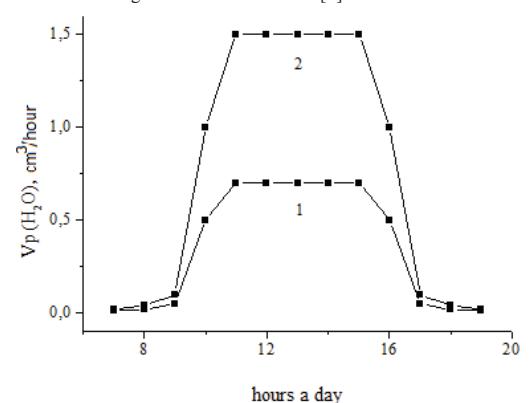
Experimentally found that the most significant of technological parameters, which determine the effectiveness of the decomposition of water, are the concentration of solar radiation, time of day during of which solar radiation is the most effective, particle size of the photocatalyst, the temperature and pH of the water. An important advantage of nanostructured photocatalysts based on TiSi2, is that they are effectively converted into chemical energy concentrated solar radiation with any degree of $K = 50-1000$ concentration of suns that can not be done by the other photocatalysts. Thus, the photocurrent increases linearly with increasing of the luminous flux concentration generated by the solar cell. The yield of hydrogen with the decomposition of water increases linearly. The optimal material for the manufacture of such photocatalysts, as was shown from obtained results is titanium disilicide (TiSi2) with particle size $\leq 70 \text{ nm}$, based on the photocatalysts which can reach 98% of efficiency.