
Isotope ratio mass spectrometry can be used as one of the experimental method which allows to evaluate total neutron flux through graphite stack of nuclear reactor [1].
Graphite was and still is an important material in Magnox, AGR, HTR and RBMK type nuclear reactors [1] in which it is used as neutron moderator. Nuclear graphite is a very pure material but it still contains some impurities of various elements which can be activated by (n, γ), (n, p), (n, α) reactions [1]. Therefore it is classified as long-lived radioactive wastes after the shutdown of a nuclear power plant. The evaluation of neutron flux can be used for the management of used nuclear graphite [1].
The objective of this work is to ascertain, how the δ13C values of not activated nuclear reactor graphite (it was used as model of nuclear graphite) depend on sample preparation (graining, pulverizing, use of oxidator V2O5) and evaluate memory effect in elemental analyzer.
In our work was used natural, not irradiated, grained graphite from Poland. The measurements were made with the elemental analyzer FlashEA 1112 connected to the stable isotope ratio mass spectrometer ThermoFinnigan Delta Plus advantage.
There were six samples prepared. There was used grained and pulverized (using manual grater) graphite, mixed with oxidator V2O5 and put into tin capsules.
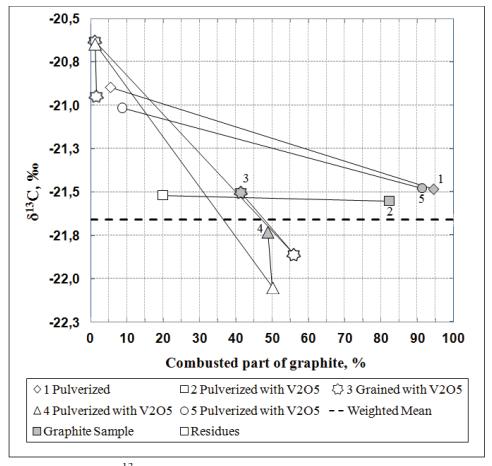
Fig. 1 shows graphite fractionation in the elemental analyzer. After each sample measurement, there were being made repeated measurements (delivering empty tin capsule into combustion furnace), until there were left no residues of graphite in the furnace.
When a sample needs more number of repeated measurements for complete combustion, it gives higher level of fractionation (samples 3, 4). It seems that during the first measurement usually burns the part of sample with lighter isotopes, giving greater δ13C values of the residues. Though two measurements were needed for complete combustion of sample 2, but fractionation in this case is very small (δ13C values of both measurements are almost identical). But possible effect of oxidator V2O5 was not confirmed by the measurements of sample 1 (without V2O5) and sample 5 (with V2O5) whose characters are very similar.
More researches must be done to determine the best graphite preparation for stable isotope ratio analysis.