
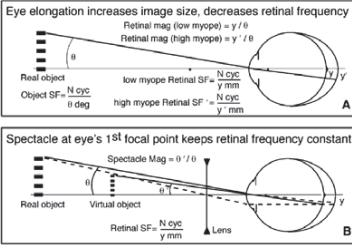
Visual acuity in periphery has a wide range in population. [1],[2]. However, if we look at the development of myopia (particularly, the axial myopia), then we see, that when the axial length of the eye increases, the distance between photoreceptors is increased, therefore the density of photoreceptor and retinal ganglion cells is lowered. It is remarked, that the retinal stretching happens mostly in foveola and near peripheral region in retina, while the rest of the retina is stretched less substantially, retaining non-uniform stretching. [3]
If axial myopia is corrected with spectacle lenses at constant vertex distance from the eye (lens placed in anterior plane of the eye), then by Knapp's law, the relationship between the object size and retinal image size is fixed. Therefore, it is possible to measure the relationship between visual acuity in both central and peripheral retina, and indirectly, to measure the photoreceptor density in retina (Fig. 1).
In literature we can find many sources implying the term perceptual learning, in particular – peripheral and central visual acuity, however it is seen, that the actual perceptual learning rarely, if ever happens. [4].
It is shown that the perceptual learning happens while subjects are freshly introduced to the task, usually the measurements that are discarded due to subject's wide array of answers, are taken into account when speaking about learning, therefore these result tend to improve in time (when subject has learned how to properly perform the task). It is then observed, that peripheral visual acuity remains unchanged with perceptual training. [4]
The resolution acuity (highest spatial frequency that can be perceived verdically) is not perceptible to central visual defocus, however, the detection acuity (highest spatial frequency (luminance gratings) that can be detected on a uniform field) is susceptible to optical defocus, that implies that resolution acuity is dependent on neural sampling density, in contrast to detection acuity, that is contrast limited (both in peripheral and central vision). [5]