
Variously modified anthracenes are in a great interest of today's science as a promising emissive material for blue organic light – emitting devices (OLED). It demonstrates good emission efficiency, colour purity and stability. However, like other planar organic compounds, anthracene derivatives tend to crystallize in thin films what strongly deteriorates colour purity and efficiency of OLED device. Additionally, for inexpensive and efficient production of anthracene – based OLED devices it is necessary to improve solubility of these compounds in common solvents. Structural modifications plays a critical role on the optical and electrical properties and the device performance, thus the detail analysis of structure-property relation is mandatory.
In this work a series of structurally modified nonsymmetric 9,10-diphenylanthracene (DPA) derivatives (Fig. 1) were investigated. To enhance film forming properties of anthracene compounds they were nonsymmetrically substituted at the 2nd position by using either phenyl or penthyl moiety. In addition to this, different length alkyl groups were attached at the para position of 9,10-phenyl substitutes to determine the impact on the fluorescence efficiency, concentration quenching and carrier drift mobility. Detailed spectroscopic analysis of these compounds in dilute solution, polystyrene matrix and neat films were carried out. Experimental data was compared with theoretical DFT calculations and electrical measurments of the compounds accomplished by partners.
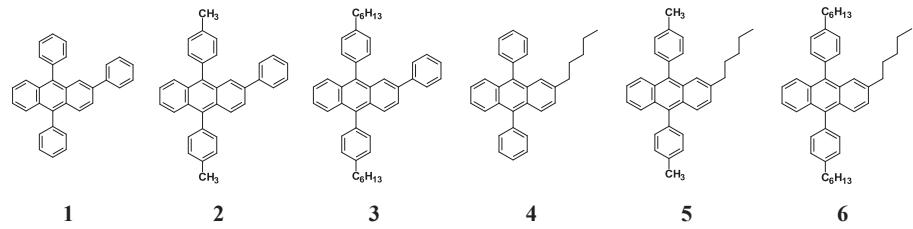
Absorption spectra of the DPA compounds 1-6 contain clearly resolved vibronic structure with the dominant 1st vibronic replica similarly to that observed in the spectra of other various DPA derivatives due to the presence of rigid anthracene core. The lowest energy vibronic bands in the absorption spectrum of the 2-phenyl substituted DPA compounds 1-3 peaks at 405 nm, whereas the bands of the 2-penthyl substituted counterparts 4-6 are shifted more in the UV (at about 391 nm) due to the worse π-conjugation of the substitutent.
Emission spectra of the DPA compounds 1-6 in the dilute solution also express vibronic bands, however a lack of the mirror images between absorption and emission implies flexibility of the molecules and geometrical transformations occurring in the excited state. In accordance with the absorption spectra, fluorescence bands of more conjugated 2-phenyl-substituted DPA derivatives 1-3 are located at 422-426 nm, and thus are slightly redshifted as compared to those of the less conjugated 2-penthyl-substituted DPA counterparts 4-6 peaking at 416-421 nm. Absorption and fluorescence measurements supported by DFT calculations revealed relatively small shifts in singlet and triplet transition energies (<100 meV), which however, caused drastic changes in the intersystem crossing rate.
The films of the compounds 1-3 and 4-6 emit in the deep blue with maxima positioned at 453-456 nm and 441-450 nm, respectively. Noticeable vibronic structure in the fluorescence lineshapes of the DPA derivatives 1-4 points out dense molecular packing in the films, whereas nearly structureless shapes observed for the compounds 5-6 implies more random molecular arrangement, which is typical for amorphous films.
DPA compounds showed high fluorescence quantum yields, up to 0.7 in a solution and up to 0.9 in a polymer host. The DPA derivatives exhibited almost no concentration quenching of fluorescence up to 8 wt% in PS matrix. Substitution at the 2nd position by penthyl moiety resulted in less pronounced concentration quenching as compared to the substitution by 2-phenyl group. The influence of the alkyl groups attached at the para position of 9,10-phenyls on the emission spectral properties was found to be insignificant, whereas they strongly affected film forming and charge transport properties. It is worth noting that the nonsymmetric DPA derivatives expressed very high hole drift mobilities of up to $4.6 \cdot 10^{-3}$ cm2/Vs for 2-phenyl-substituted compounds and up to almost $1 \cdot 10^{-2}$ cm2/Vs for 2-penthyl-substituted analogues at an electric field of 1 MV/cm.