
Nowadays, many modern experiments require high-power ultrashort laser pulses. Such pulses are a basic tool in chemistry or biology where most of the processes proceed on an ultrafast time scale. To investigate such processes pump-probe spectroscopy methods are often used, where temporal resolution is limited by the length of the laser pulse. Furthermore, experiments in photochemistry or photobiology additionally require tunability of central wavelength over a broad spectral range [1]. To generate such pulses optical parametric amplifiers (OPA) based on three-wave interactions in $\chi^{(2)}$ nonlinear crystals are widely used. However, in this case effective generation of ultrashort pulses can be achieved across visible (VIS) and infrared (IR) spectral ranges. An alternative way to generate such pulses is based on four-wave mixing (4WM) phenomenon in transparent $\chi^{(3)}$ isotropic media which allows to produce ultrashort pulses in a wide sprectral range from vacuum ultraviolet (VUV) to IR. In this paper we report that ultrashort VIS pulses can be generated by 4WM during filamentation of an intense near-infrared (NIR) laser pulse in ambient air.
All the experiments were performed using a Ti:sapphire laser system, which generates ultrashort pulses of 100 fs (FWHM) duration with a central wavelength at 800 nm, a repetition rate of 1 kHz and an energy per pulse of 3,6 mJ. NIR laser beam was splitted into two parts using a beam splitter. One beam was focused into ambient air to produce a filament, while the other one was used to pump OPA. The central wavelengths of the IR beams (signal and idler beams from the OPA) were ranging between 1.2-1.6 μm (s-polarization) and 1.6-2.4 μm (p-polarization). The NIR and IR pulses were intersected using a dichroic mirror. The delay between these pulses was controlled by an optical delay line. Due to the strong nonlinear interaction between IR and NIR pulses during their copropagation, efficient 4WM was observed within the filament.
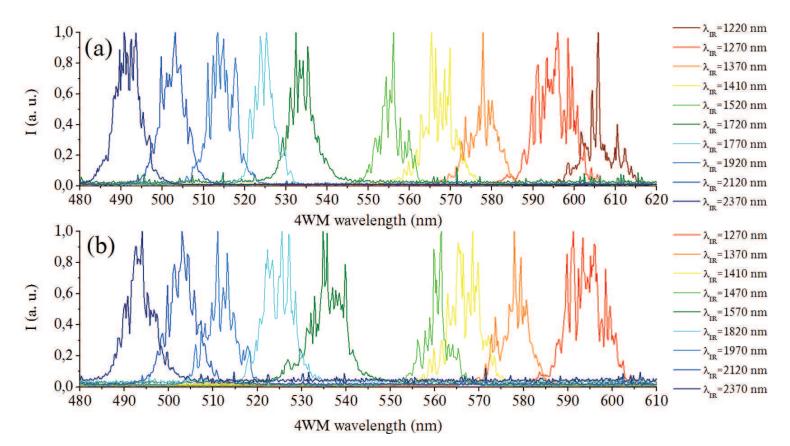
Spectra of the 4WM pulses generated in air were registered for various polarizations and wavelengths of the IR beam. It was found that in both cases (when polarizations of IR and NIR pulses are parallel (Fig. 1a) and perpendicular (Fig. 1b)) the wavelength of generated 4WM pulses is inversely proportional to the IR wavelength and the frequency of the generated pulse is determined by $\omega_{4WM} = 2\omega_{NIR} - \omega_{IR}$.
In conclusion, the efficient generation of tunable ultrashort pulses was demonstrated. Maximal achieved conversion efficiency from IR signal to 4WM signal was about 12 %. Obtained results indicate that the ultrashort VIS pulses can be generated through 4WM in ambient air.