
Plasmonic energy conversion is known as a promising alternative to electron-hole separation in semiconductor devices [1]. This method is based on the generation of hot electrons in plasmonic nanostructures through electromagnetic decay of surface plasmons. Here are presented the fundamentals of using titanium oxide based nanostructures (TiO2) and special attention is paid towards the possibility of mass-producing cheap and effective photovoltaic devices. This new method of using semiconductor nanoparticles on structured TiO2 substrates offers a low cost method of fabrication with high conversion efficiencies. Thus, the modelling of nanostructured TiO2 cells for plasmon-enhanced photocatalysis plays an important role for more efficient conversion of solar energy in photovoltaic and photocatalytic devices.
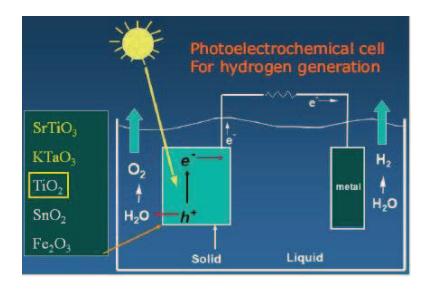
Among the many investigated photocatalyst materials for the past decades, TiO2 remains the most popular candidate for applications in solar cells, solar fuels, and environmental cleaning [3-5]. It is due to its outstanding and unique physiochemical properties. The properties of TiO2 can be widely altered by introducing defects in the crystal lattice and by doping. TiO2 is much cheaper than other photosensitive materials and its reserves are abundant. All these factors, so far, make TiO2 superior for energy and environmental applications in comparison to other heterogeneous photocatalysts.
Nanostuctures based on TiO2 has received a great attention due to different physiochemical properties as compared to its bulk form [6]. It is reported that TiO2 have enhanced photoactivity owing to its particle size and reduced recombination rate. The anatase phase is considered to be the active element in the mixed phase, whereas the rutile acts as an electron sink to reduce the recombination rate [7]. Overall, TiO2 as nanostructures offers high surface to volume ratio and short path for charge carriers to the surface (especially for photogenerated holes).
Thus, operation of the catalytic system requires charge carrier transport to the surface, that is why the main problem still remain the charge carrier recombination. That problem can be successfully solved by the design, fabrication technics. Modeling of TiO2 based photocatalysts could greatly simplify this problem through the optimization of its their performance and further understandings of the mechanisms for enhanced photocatalytic activity.