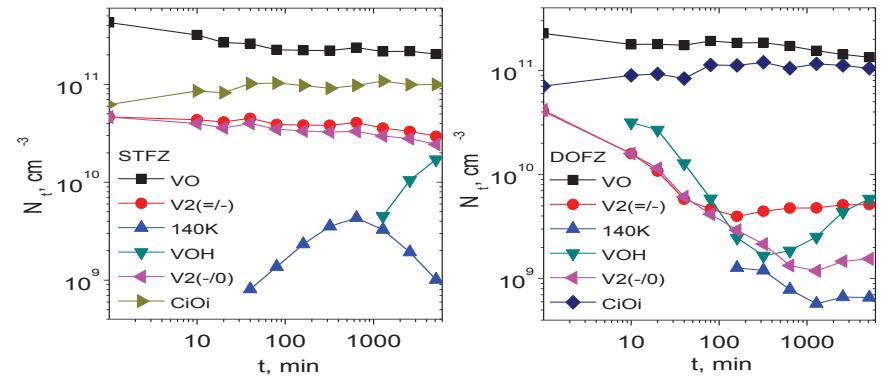
Dependence of the device electrical characteristics on fluence is essential in evaluation of the functionality of high-energy particle detectors under high fluence irradiation conditions. In this study, radiation damage in standard float zone (STFZ) and diffusion oxygenated float zone (DOFZ) Si detectors irradiated by electrons have been investigated by means of capacitance deep level transient spectroscopy (C-DLTS). DLTS is widely used method for studying deep level defects in semiconductors. DLTS method is used for the measurement of a deep-level activation energy, the concentration of the defects and the capture cross section. C-DLTS is based on measurements of the capacitance transient signals resulting from relaxation processes, following the abrupt changes of bias voltage and temperature [1].
The samples were irradiated with 3.5 MeV electrons. Irradiation fluence was 1012 e/cm2. The irradiated samples were subjected to isothermal annealing at 250 °C temperature for different time intervals. The analysis of the C-DLTS spectra shows that the electron irradiation creates vacancy-oxygen, divacancies and carbon related defects. CiCs complex was detected only in STFZ Si sample, because the introduction of CiCs depends in the concentration of Cs and Oi. In oxygenated sample reaction channel Ci+Ot→COi is favoured. The annealing caused formation of unknown deep level (peak at 140 K) and VOH defect (Fig. 1). It was revealed that increasing in the concentration of VOH defect leads to the decreasing of the concentration of unknown defect level. The concentration of all electron traps decrease during annealing, and is less in DOFZ Si than in STFZ Si diode, while the concentration of all hole traps is increasing during annealing, and is higher in DOFZ sample.