Carbon nanotubes are large molecular systems made entirely of carbon atoms. Structurally, they can be viewed as a graphene sheet rolled-up in some particular direction to make a tube. Since their discovery few decades ago, they have inspired a lot of theoretical and experimental studies as they show better electrical and mechanical properties than other ordinary materials [1]. One special feature that attracted a lot of attention was the dependence of the energy gap on the nanotube's diameter and geometry, which led to speculations that one day carbon nanotubes could replace silicon transistors. In this research, we performed various calculations concerning the density of states in carbon nanotubes, from which the energy gap can be calculated.
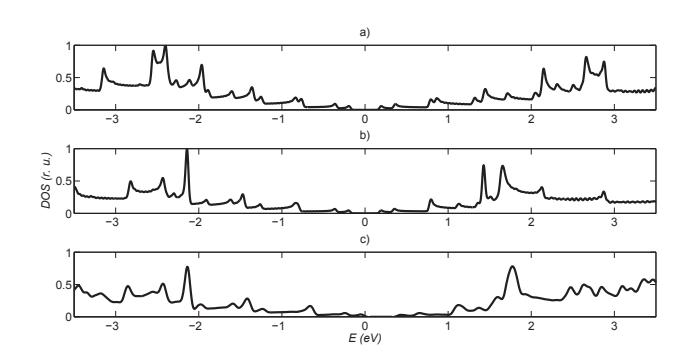
The goal was to check whether or not including additional neighbouring atoms in the tight-binding model increases accuracy of energy dispersion relations. Our work was based on the fifth-nearest-neighbour tight-binding (5NNTB) description of electronic structure of graphene [2] which proved to be more accurate than previous models. We expected to see similar improvements when applied to carbon nanotubes, though we ignored curvature effects on $\sigma$ bonds and relative position of atoms. Using zone-folding method [3], we obtained energy dispersion relations for carbon nanotubes, which were compared with results obtained by Density Functional Theory (DFT) implemented in Vienna Ab-initio Simulation Package [4, 5]. The results showed great improvements when the influence of more distant atoms was taken into account. As shown in Fig. 1, in this case the form and position of van Hove singularities resembles those obtained from DFT calculations.
Moreover, after analyzing carbon nanotubes of different diameters, we concluded that all carbon nanotubes with diameter less than 8 Å have a degeneracy point between the conduction and valence bands due to distortion of the $\sigma$ bonds. Also, we found that the energy gap is inversely proportional to nanotube's diameter. Hence the new tight-binding model is good improvement from earlier models and is a good approximation for those carbon nanotubes that have small curvature.