
Pyrimidine derivatives are organic compounds that have a benzene ring and two nitrogen atoms at positions 1 and 3. These derivatives are one of the main DNA nucleic acid consisting parts [1]. Pyrimidine and their derivatives are well known due to their biological activity [2]. These compounds show antibacterial, antiviral, antimicrobial, antitumor, antituberculous properties [3]. It was observed that pyrimidine derivatives have an efficient fluorescence and that they are sensitive to the polarity of the environment [4]. Therefore lots of research has been carried out recently seeking to adapt these compounds in the manufacture of sensors and biosensors [5].
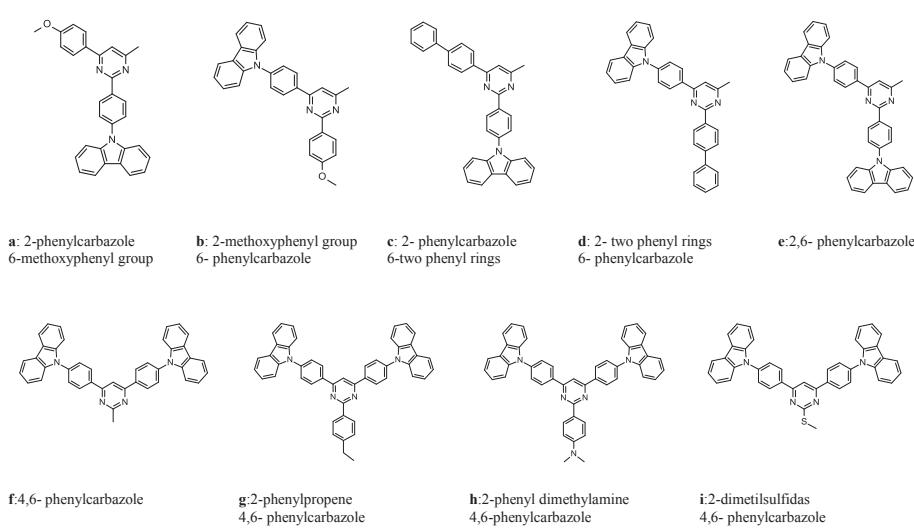
In this work a new series of pyrimidine derivatives has been studied. The pyrimidine compounds differ in substituents and their positions (see Fig 1). The aim of this work was to find out the dependence of the photophysical properties of pyrimidine derivatives on different substituents and their positions and also on various solution polarity. For that reason, pyrimidine samples were made using four solutions with increasing polarity: toluene, chloroform, acetone, dimethylformamide. To find out all the optical properties measurements of absorption and fluorescence spectra, fluorescence quantum yields and lifetimes were carried out.
Pyrimidine compounds have demonstrated high fluorescence quantum yields (up to 75%) in a wide spectrum range (from 378 nm to 520 nm). The fluorescence efficiency of the derivatives in a polar environment is influenced by two competing factors. One of them is increased radiative fluorescence lifetimes ( from 3-4 ns in a nonpolar solution to 8-51 ns in a polar solution) due to intramolecular charge transfer. The other one is increased nonradiative fluorescence lifetimes (from 1,5-7 ns in a nonpolar solution to 16-27 ns in a polar solution) due to reduced intersystem crossing.