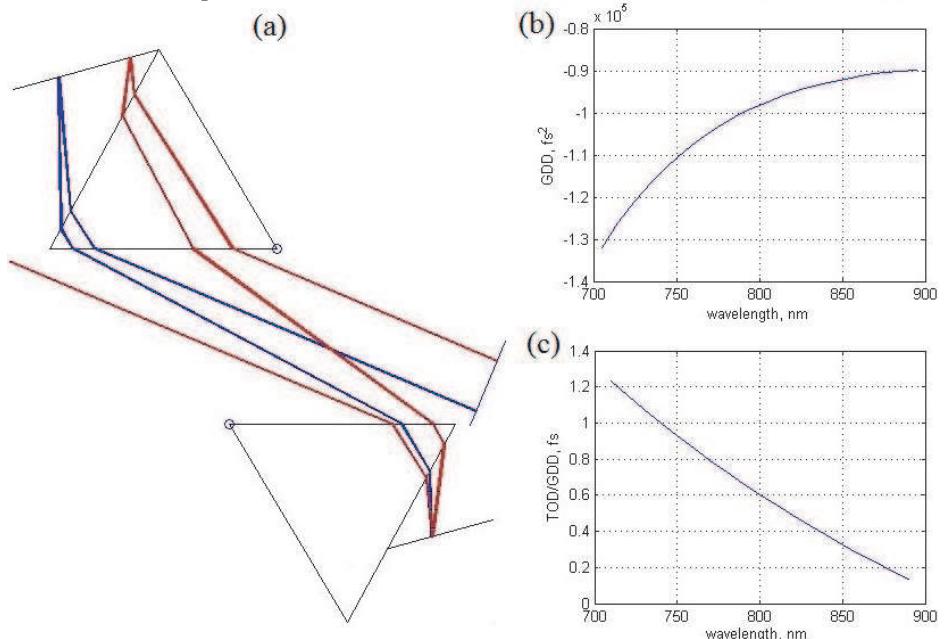
In optical parametric chirped-pulse amplification (OPCPA) systems, high power pulses with bandwidth-limited durations are desired [1]. To compensate the dispersion of the optical system, we use a grism-pair stretcher, composed of two pairs of prisms and reflective diffraction gratings [2]. This kind of stretcher is noted for its flexible control of dispersion and compactness, which is important, as minimising the length of air a pulse must travel through reduces the disturbances in its path, keeping the pulse phase more stable. Because a laser beam's path through a grism stretcher involves many refractions and reflections, efficiency becomes an essential issue.
We used computer ray tracing software, developed in our lab, to model grisms with desired and flexible dispersion characteristics as well as acceptable efficiency. In describing the phase characteristics of the stretcher, the spectral phase Taylor expansion coefficient values are used, primarily group delay dispersion (GDD) and third order dispersion (TOD). To compensate our system's dispersion and work well in tandem with the AOPDF, the target parameters of the grisms are -100000 fs2 GDD and 0.6 fs TOD/GDD for the central wavelength of the 700-900nm bandwidth. In the model, SF10 glass and 600 grooves/mm gratings were used. The calculated efficiency coefficient of $\eta$=0.56 is quite acceptable, as the laser beam refracts 16 times and reflects off of the gratings 4 times during its traversal of the grisms. To attain the maximum efficiency, the refractions all happen very close to the Brewster's angle, which, to the best of our knowledge, has never been achieved before in a grism stretcher.