Oxide ion conductors have been widely studied for use as components of fuel cells, oxygen sensors, oxygen pumps and oxygen-permeable membrane catalysts. The Aurivillius family of structurally related oxides with general formula Bi2An-1BnO3n+3 were originally of interest because of their ferroelectric properties, but they have been recently studied for possible use as oxide ionic conductors.
Previously Bi2MO6 were synthesized by many different methods, such as coprecipitation, solid-state reaction, sol-gel, combustion synthesis, ultrasonic and hydro/solvothermal. In this study we investigate material synthesized by relatively new Micro-Wave synthesis method.
Prepared polycrystalline were characterized using X-ray diffraction (XRD), IR spectroscopy followed by differential thermal analyses (DTA) coupled with thermogravimetry (TG). Finally ceramics for impedance and electronic conductivity measurements were prepared. To determinate sintering temperature thermal XRD analysis as well as dilatometry measurements were used. Fine quality ceramics (more than 85% of calculated density) were covered with 9 nm platinum electrodes using magnetron for impedance spectroscopy.
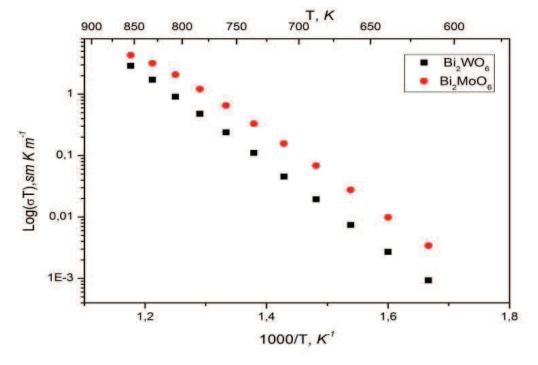
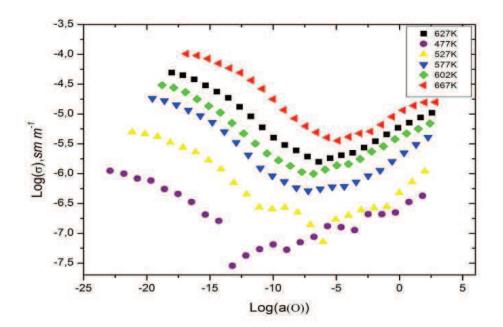
Total conductivity for all the samples were measured using impedance spectroscopy method in range of temperatures from 600 K to 850 K in dry air atmosphere. Electronic conductivity were measured using modified Hebb-Wagner polarization method in temperature range from 600 K to 940 K.
Both samples showed similar mixed conductivity with activation energies of 1.44 eV for Bi2WO6 sample and 1.29 eV for Bi2MoO6. Partial electronic conductivity in normal oxygen activity is only minor. In both cases electronic conductivity showed strong dependence of partial oxygen activity.