
Spatial periodic modulation of the refractive index on a wavelength scale in photonic crystals (PhCs), provides control of both temporal and spatial dispersion properties of light waves, in the latter case offering the possibility to manipulate the spatial propagation of the light beams. PhCs of particular geometries may provide anomalous spatial dispersion for a beam propagating inside the structure that can lead to the so called flat PhC lensing [1] effect.
The concept of flat PhC lensing is based on the transforming the phases of the different spatial spectrum field components. The convex-curved phase-shifts of field components accumulated during the propagation inside the PhC can be compensated by usual concave-curved phase-shifts during propagation in the homogeneous material, both in front and behind the PhC, resulting in focusing behind the PhCs.
Such focusing has been experimentally shown only for microwaves [2] and for sound waves [3]. Moreover even the 1D focusing/imaging by PhC slabs was demonstrated only in the near infrared frequency range [4]. Here full two-dimensional (2D) focusing by a polymer based three-dimensional (3D) woodpile PhC is demonstrated.
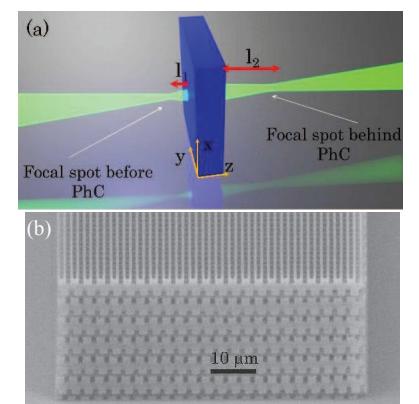
PhC samples were fabricated in hybrid organic inorganic sol-gel photopolymer by direct laser writing technique. The PhC parameters used in FDTD calculations and experiments were the same: transverse period dx = 0.9 μm, longitudinal period dz = 6 μm, (filling factor 70%), transverse dimension 80 μm, and length of the crystal L ~ 30 μm (5 longitudinal periods).