
During the last 15 years vertical cavity surface-emitting lasers (VCSELs) were firmly established in the laser diode market and found numerous application areas from multimode fiber optical networks and computer mice to diverse sensing and illumination purposes. Whereas significant progress in VCSEL performance and description has been achieved over the last ten years, there are still relevant problems in their modelling and application. Particularly, controlling the state of polarization, which is highly important for a large number of polarization-sensitive systems, achieving higher (more than 25 Gbit/s) digital data rates and etc.
The present work illustrates usability of the proposed phenomenological model of the polarized radiation formation in the semiconductor injection lasers. The dynamic and spectrum effects of the polarization switching (PS) on the basis of this model are considered.
The theoretical model is based on the polarization components method (PCM). Within this method the field of a plane wave is represented as a superposition of a large number of polarized components. The quasi steady state approximation allows regarding different frequencies independently and introducing frequency components as well. Each polarization and frequency component is described by the rate equation, written in the slowly varying envelope approximation, and the rate equation of carrier concentration is introduced. Gain shape is assumed to have Lorentzian shape with the peak frequency depending on the injection current. Longitudinal mode structure is taken into account by spectral dependence of the reflection coefficient. Further, the numerical methods were used for the solution of the obtained system of equation. Calculations were hold for a wide set of parameters values, parameters of the active medium were correlated with ones of the GaAs heterostructures.
Numerical modeling, based on the approach mentioned above, allows to describe polarization effects in the single-mode semi-conductor injection lasers, which are observed experimentally: effect of PS (both with the switching from the mode with higher frequency to the mode with lower frequency and vice versa, see Fig. 1), polarization hysteresis, injection-current and frequency shift of the PS in lasers under the external injection of the polarized signal, dependence of the speed of PS on the duration and polarization angle of the injected impulse, etc.
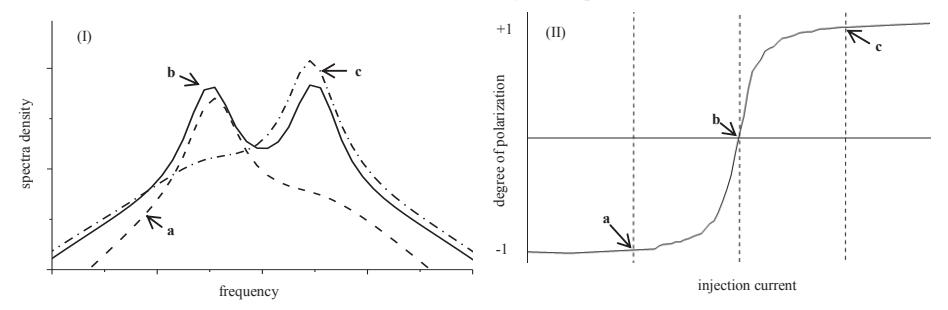
The obtained results give simple and consistent physical interpretation of the experimental data, described in the literature on the dynamics of PS in VCSELS (e.g. see [1]), predicts the correlation between characteristics of the output radiation and the parameters of the injected signal. The basic difference of the proposed approach from the widespread spin-flip model [2] of the polarization properties of semiconductor lasers consists in the absence of the rigid conditions on the phase and polarization structure of the radiation, which is formed during the formation of radiation in the laser cavity. It is important to note, that there is a possibility of broadening of the worked-out approach on the description of the higher (not fundamental) modes of the laser output radiation and studying of the specific laser systems, either semiconductor or solid-state.