
Near infrared excitation within the tissue transparency window in the region 650 - 1350 nm provides deeper penetration in tissues for imaging and sensitization applications. Biological molecules, photosensitizers, biomarkers and photo-drugs as a rule have no absorption in this spectral region, therefore, cannot be effectively excited. This can be overcome by the use of two photon excitation. In case of quantum dots (QDs) two photon absorption (TPA) cross sections are superior to those observed in conventional photosensitizers. However photophysical properties upon two-photon excitation of quantum dots are yet poorly understood.
The CdSe/ZnS core shell quantum dots of different size were used for the experiments. The two photon excitation of samples was performed by using home-made optical parametric amplifier ($ \lambda=650 $ - 2500 nm) pumped by femtosecond “PHAROS” laser system. Two-photon absorption cross sections were evaluated by a comparative method with Rhodamine B as a reference compound [1]. The experiments were carried out in the Laboratory of Biomedical Physics, Institute of Oncology, Vilnius University with Deividas Sabonis as the head of the research.
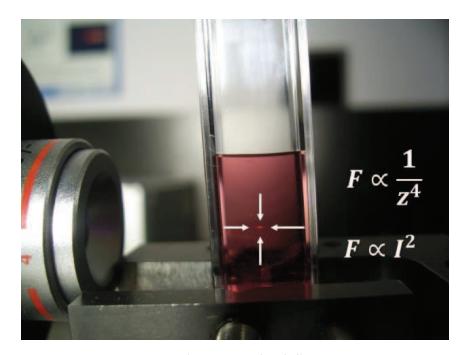
Our results confirm that QDs have high enough TPA cross sections compared to organic dyes. This is paramount for applications and further optimization of two-photon properties of such nanoparticles. Such large TPA cross-sections make them efficient absorbers for multiphoton biological imaging and other nonlinear optical applications.