
Graphite is an important material used to moderate neutrons in nuclear reactors. It is evaluated that about 250,000 tons of spent graphite are already accumulated in still operating or being decommissioned nuclear reactors. In spite that nuclear graphite is a very pure material, it still contains some impurities of various elements. These impurities and carbon are activated by neutrons resulting in long-lived elements (e.g., 14C, 36Cl, transuranium elements). Therefore it is very important to know the radionuclide composition of the material in order to safely manage nuclear waste [1].
The aim of this work is to find optimal preparation of the sample and conditions at which precise carbon isotope ratio could be measured.
All carbon isotope data are reported in the delta notation $\delta^{13}$C or differences from the given standards, expressed in parts per thousand (‰) and are calculated according to the formula:
$$ \delta^{13}C = \left(\frac{\left(\frac{^{13}C}{^{12}C}\right)_{\text{sample}}}{\left(\frac{^{13}C}{^{12}C}\right)_{\text{standart}}} - 1\right) \times 1000\text{‰} \tag{1} $$Samples from Poland of virgin graphite (not irradiated) have been shredded into small and flat particles. Measurements of the carbon isotopic composition of graphite have been made with the Elemental Analyzer (FlashEA 1112) connected to a stable isotope ratio mass spectrometer (ThermoFinnigan Delta Plus Advantage). Carbon analysis has been performed after sample combustion in an oxidation furnace at the temperature of 900 K with the oxygen excess.
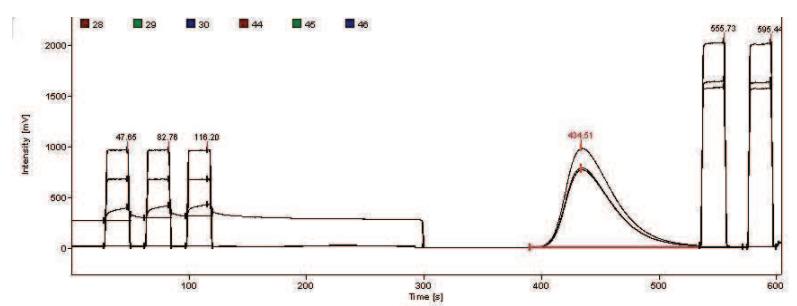
As seen in Fig. 1, the curve of measured graphite sample intensity over time (starts at 400th second) is asymmetric. It indicates that some of graphite was left unburned in the combustion oven. That was common for most samples. Therefore, samples must be well shredded for precise results. It was found that all burns that are left in the combustion oven are enriched with 13C isotope and affects $\delta^{13}$C value of the next measurement. Quantity of unburned graphite only depends on the properties of the sample (size of shredded particles) [2].
Measured $\delta^{13}$C values varied from -18.99 ‰ to -22 ‰ for virgin graphite and from -25.03 ‰ to -28.54 ‰ for irradiated graphite from Ignalina RBMK reactor. $\delta^{13}$C values of irradiated graphite give possibility to estimate the neutron flux in the certains points of the graphite stack.