Sapphire due to its excellent mechanical and optical properties is widely used in optoelectronic and microelectronic applications. Besides its wide use in high power laser optics, sapphire gained interest as a good substrate for gallium nitride (GaN) growing in light emitting diode (LED) technologies. Unfortunately, because of its hardness and chemical stability, it is difficult to apply traditional machining methods and tools to sapphire crystal, especially when precise machining is needed. However, ultrafast lasers become a promising tool for micromachining all sorts of materials, including sapphire. Cutting and micropatterning of sapphire surface is extensively studied nowadays [1]. Moreover, with femtosecond laser machining it is possible to integrate various photonic devices directly into the bulk of transparent materials [2]. This technology was successfully demonstrated in a wide variety of glasses; however, the integration capabilities into sapphire are not well documented. It is known that focused femtosecond laser pulses can modify sapphire properties [3], but this result is still waiting to be exploited.
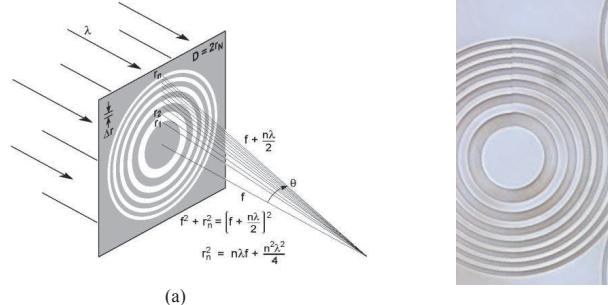
In this work we attempted to integrate Fresnel zone plates with diameters up to 300 μm in the volume of sapphire crystal by direct laser writing technique. Plate consists of series of concentric rings (zones) with periodically altered light transmission properties. The working principle of a zone plate relies on the diffraction of light, i. e. the incident monochromatic light is diffracted by the periodically alternating zones and, depending on the dimensions of the zones, constructively interferes at a designed focal point (see Figure 1). These zone plates are intended to be integrated directly into GaN LED substrate: due to the fact that sapphire can transmit UV wavelengths, the ability of a zone plate to focus this type of radiation and the fact that the largest volume of sapphire production is expected to be for substrates for high brightness LED devices [4], it would be advantageous to employ sapphire not only as a substrate but also as a medium for integration of zone plates which could potentially increase the efficiency of UV LED devices.
For integration tasks we used femtosecond (300 fs) high repetition rate (100 kHz) Yb:KGW laser pulses together with high precision linear positioning stages. By exposing sapphire to focused femtosecond laser radiation, regions of modified refractive index were induced and required zone plates were patterned. The discussions about optimal fabrication parameters and patterning algorithms as well as focusing properties of fabricated zone plates are presented in this study.