
The array of parallel cylinders is a convenient object while investigating complex structures, which possess properties that can be used in electronics. Structures from periodic cylinders - photonic crystals - are used in optics as elements of objects which control a beam. Photonic crystals of macroscopic elements are convenient because one can easily manipulate them without any special equipment and the requirements for the precision of processing of the surfaces are lower [1]. The problem of electromagnetic wave scattering by a finite cylinder set is once again interesting due to the possibility of modeling different type structures [2]. These structures should have perspective properties for their application in electronics and be made from materials with high absorption. Also further development should be made for the problems arising in the range of THz waves [3]. Absorption is important because it is highly affected by changes in the density and mobility of charge carriers inside a structural element of a photonic crystal. The main advantage is that the concentration of charge carriers and their mobility can be changed by altering the illumination, temperature, direct magnetic field. By doing this one can change the electrodynamical properties of the structure. Calculating techniques allow us to solve boundary problems of complex two-dimensional structures made from cylinders [4]. Another reason, which caused the renewed interest in scattering problems, is the creation of metamaterials and problems arising from their application in electronics.
After solving the boundary problem we find magnitudes of cylindrical waves. With a set of field values one can characterize the system with the required accuracy. It isn't convenient because we have to operate with large amounts of data. Here we investigate the energy absorbed and scattered per length unit per period of an array of cylinders placed equidistantly along axis x. While studying these parameters, with different electric properties of the cylinders, distance between the cylinders, the polarization and frequency of the wave, we try to deepen our knowledge of the phenomenon and hopefully find some kind of patterns.
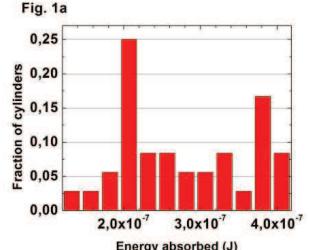
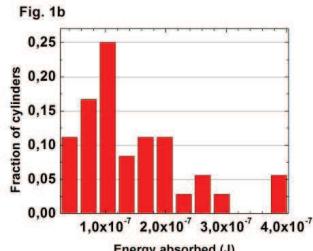
Here we present the dependencies of the fraction of number of cylinders on absorbed energy per period per unit length for a set of N=36 identical cylinders placed along the direction of propagation of incident wave with perpendicular (a) and parallel (b) polarization of wave. The distance between centers of cylinders is 4.2 mm. One can see the close absorbed energy values can have different number of cylinders and an energy gap can occur (see Fig. 1b). The incident wave is a monochromatic linearly polarized plane wave. The cylinders under investigation are made from silicon, which has the permittivity $\epsilon_{\text{si}}$=11.8-(i/($\omega\rho$)), here $\omega$=2$\pi$f, f=12GHz (frequency of the incident wave), $\rho$ - specific resistivity, $\rho$=10$\Omega$m. The radius of cylinder R=2mm.