
Biosensors can be applied in various samples including body fluids and environmental samples. We used innovative Screen-Printed Graphene Electrodes (SPGPHEs), because of high surface area of graphene, thermal and electric conductivity. The electrodes were modified with nanoparticles to improve the electrocatalytic properties toward b-Nicotinamide (NADH) oxidation, so that it can be used for electrochemical biosensor device [1]. Our results are shown in Fig. 1. The Fig. 1a is TEM image of the triangular ruthenium nanoparticles obtained using hydrothermal synthesis method [2].
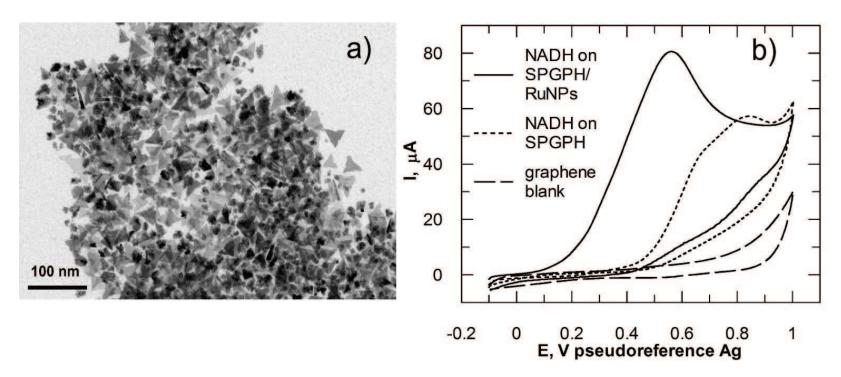
As shown in (Fig. 1), curves are cyclic voltammograms of NADH on bare SPGPHE (dot) and SPGPH/RuNPs modified electrode (line), graphene blank (dash). A remarkable catalytic oxidation current at the modified electrode occurred at ca. 0.2 V, which negatively shifted higher than 350 mV, compared with that at bare SPGPHE (ca. peak potential at 0.870 V). The electrocatalytic current decreased significantly (more than 40%) when the RuNPs were absent from the electrode surface. Our results demonstrated that the SPGPH/RuNPs maintained a good electrochemical activity toward NADH and could be applied to the field of electrochemical biosensors.