
In majority of studies, carrier recombination processes are investigated in complex LED structures, where the basic processes are considerably obscured due to the structure-specific features like built-in electric field, carrier localization because of well thickness variation, or impact of electrical contacts. To avoid these additional factors, we performed optical study of thick AlGaN layers seeking to clarify the radiative and non-radiative recombination pathways, and carrier localization influence to them in AlGaN.
We studied 10 μm thick AlxGa1-xN layers with different molar concentrations of Al (48 – 71%), grown using MEMOCVDTM on the AlN/sapphire templates. To assess the parameters of carrier localization, photoluminescence (PL) measurements under quasi-steady-state conditions were performed in a wide range of excitation power densities from 10 kW/cm2 to 10 MW/cm2 at the temperatures ranging from 8 to 300 K. Carrier lifetime $\tau_R$ and diffusivity D was measured using light-induced transient grating (LITG) technique. Transient gratings of different period (1.9 – 7.8 μm) were recorded using 25 ps pulses at 213 nm with energy fluence ranging from 0.016 to 0.48 mJ/cm2 and temperature varying from 80 to 420 K.
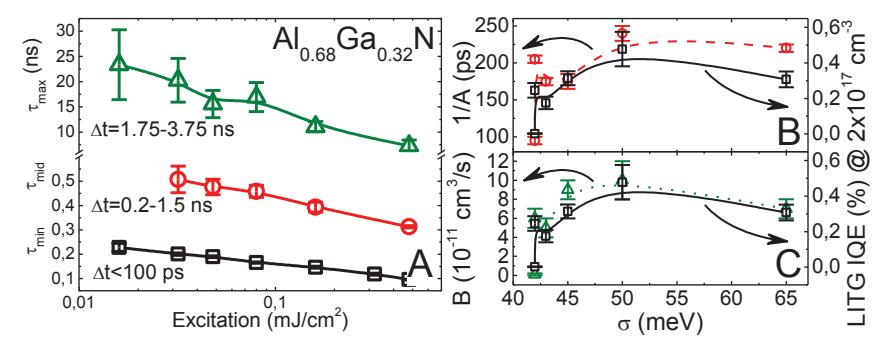
LITG decay revealed non-exponential kinetics with at least three distinct components. Assuming these components reflect independent decay processes, we fitted them with a single-exponential function within three distinct decay ranges. The corresponding decay time constants $\tau_{min}$, $\tau_{mid}$ and $\tau_{max}$ of those components at moderate injection (0.16 mJ/cm2) varied from sample-to-sample within ranges of $\tau_{min}$=75–150 ps, $\tau_{mid}$=95–475 ps and $\tau_{max}$=7–23 ns. Decay rate of all components increased with injection (Fig. A) due to emerging radiative recombination (for fast decay component), and localized states filling (for slow decay component). Carrier nonradiative recombination rate A decreased with increasing localization depth σ (Fig. B) due to diminishing probability of carrier capture to nonradiative recombination centers, reaching the minimum value at σ~50 meV. However, further increase of structural disorder initiates deterioration of crystal quality and rise of recombination states. Nonradiative recombination rate increased with temperature possibly due to multiphonon emission.
The determined radiative recombination coefficient B of the best quality AlGaN layers was (5 – 10)x10-11 cm3/s, and increased with localization depth (Fig. C.), reaching the maximum value at σ~50 meV. Temperature dependence of radiative recombination coefficient matched theoretical function B~T3/2 within the experimental uncertainties.
Two sets of internal quantum efficiency (IQE) values were estimated using independent LITG and PL techniques. Both sets of IQE values positively correlated with each other, nonradiative recombination decay time 1/A and radiative recombination coefficient. IQE increased with localization depth, reaching the maximum value at σ~50 meV (Fig. B and C).
The diffusion coefficient D of all AlGaN layers was immeasurably small (<0.1 cm2/s), and not increased neither with temperature nor with nonequilibrium carrier density. Therefore nonradiative recombination was not diffusion-governed process within temperature range of T=80–420 K.