
Active galactic nuclei (AGN) are some of the most luminous sources in the Universe. Their characteristic light spectrum is different from stars and it is believed that their energy source is accretion of gas on to a supermassive black hole (SMBH) instead of nuclear fusion. Gas forms a disc around the SMBH in which it slowly spirals in towards the center due to viscosity. Strong gravity of the black hole forces gas to move at high speeds and heats up the gas. Inside the disc temperatures can reach more than ~106 K resulting in strong thermal radiation with a peak at X-ray wavelengths. This radiation can have enough pressure to create line-driven winds by pushing out part of the gas from the disc. Such winds produce massive outflows which can influence further evolution of parent galaxy by either blowing out and heating the surrounding gas and thus stopping further star formation or enveloping and compressing dense molecular cloud thus accelerating star formation. In this work, we model accretion discs with different feeding rates and calculate the resulting mass loss rate due to wind.
We calculate accretion disc evolution around a 108 M☉ SMBH. We use a 1D code which integrates the disc evolution equations derived in [1]. We use the $\alpha$ disc prescription in which viscosity is equal to $v = \alpha c_s H$ [2], where $c_s$ is the sound speed inside the gas, H – disc height and $\alpha$ – proportionality parameter which is equal to 0.1 [3]. The disc is modeled from 3 to 1000 Rschw (Schwarzschild radius – radius of the black hole's event horizon), because orbits at smaller radius are unstable and at larger radius gas self-gravity might occur which is not accounted for, might become important. During its evolution the accretion disc is being supplied with gas at a constant rate from an external source at a distance 500 – 600 Rschw. Gas supply rates vary from 0.0022 M☉ yr.-1 to 22 M☉ yr.-1 (or 0.001 to 10 times the Eddington accretion rate, which for 108 M☉ black hole is equal to 2.2 M☉ yr.-1, at the Eddington accretion rate, radiation pressure becomes equal to the force of gravity) in different models.
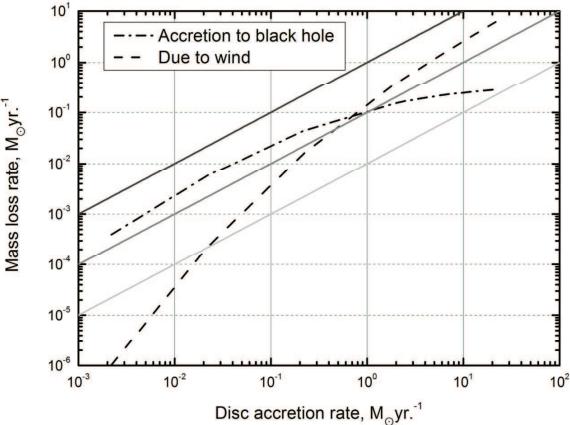
The dependence of both maximum mass loss rates due to wind and accretion rates on to the SMBH on the disc feeding rate is shown in Figure 1. When the feeding rate is much smaller than the Eddington accretion rate, the wind is negligible and most of the gas falls on to the SMBH. When the feeding rate increases the wind becomes progressively more important and exceeds the SMBH accretion rate at feeding rate of ~0.8 M☉ yr.-1. At the highest feeding rate mass loss due to wind is equal to ~30% (or ~6.5 M☉ yr.-1) of the feeding rate thus creating massive outflows. At the same time accretion on to the SMBH starts to reach saturation at ~0.55 M☉ yr.-1 because most of the gas gets blown away before it is able to reach the centre of the disc. This saturation means that SMBH accretion does not reach the Eddington accretion rate. Also due to limited radius of the modeled disc most of the gas (~70%) escapes through the outer edge. Expanding the radius at which disc properties are being calculated is our future goal.