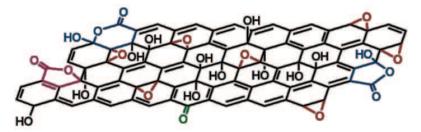
One of the most widely used and investigated graphene-based nanostructures is graphene oxide (GO). GO has a large surface area and a variety of oxygen functional groups (carboxy, hydroxy, epoxy, etc.). It is thought that hydroxyl and epoxy groups are present in high concentrations on the basal planes, and carboxylic groups are situated around the periphery of the residual graphene sheet (Fig. 1). Functional groups are responsible for the hydrophilic properties and dispersibility of GO in water. Due to the abundance of functional groups, GO sheets in aqueous dispersions are negatively charged [1]. Another type of graphene nanostructures is exfoliated graphene oxide (GOE). GOE can be produced from GO at high temperatures. GOE has a significantly increased distance between the graphene layers and reduced amount of the oxygen-containing functional groups. After exfoliation, conjugated $\pi$ electron system in graphene layer is partially restored, so GOE is electrically conductive. The nanoscale sheets of GO and GOE can react with molecules containing different functional groups including proteins. For example, bovine serum albumin protein due to hydrophobic and electrostatic interactions can be adsorbed on the surface of the GO [2]. In this way, graphene-based nanostructures can be adapted to different types of biosensors. Recently, GO has been adapted to DNA detection [3].
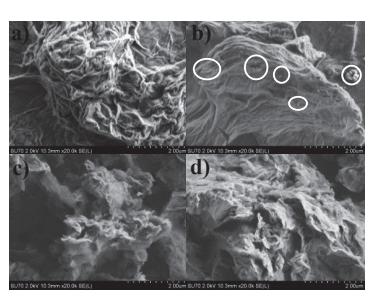
In our work GO was synthesized from graphite using a Hummers and Offeman method. GOE was made from GO at high temperature. For investigation of GO and GOE interaction with protein molecules egg white proteins were used. Analysis was performed using gel electrophoresis, dynamic light scattering (DLS), scanning electron microscope (SEM), Fourier transform infrared spectroscopy (FT-IR) and Boehm titration methods. The results of the analysis showed that GO and GOE interact differently with protein molecules. In the case of GOE, interaction with protein molecules is weaker than GO. It is considered that this is due to the smaller amount of oxygen functional groups on GOE surface compared with those of GO. We also determined that contact of proteins with GO and GOE results in GO and GOE surface morphology changes.