For applying with the most efficiency biological preparations must meet the strict storage conditions. This problem can be solved by using as a "container" for the storage and transport of bacteria porous materials such as porous silicon. The advantage of porous material is the ability to provide a relatively constant conditions within the pores, allowing bacteria in such a pore to be isolated from the environment. This allows to extend the shelf life of the drug and to exclude fermentation process.
Bacillus subtilis are a group of Gram positive, spore-forming, aerobic bacteria. Morphological features: the vegetative cells of culture represent sticks bacillary form of a size 0.6-0.7 \times 1.0-1.3 μm with rounded ends. Experimental studies showed that using of porous materials as carriers for inoculum leads to concentration of spores in obtained in this way biopreparation $1.3 \times 10^9$ /ml, which is 32% higher than with conventional inoculum.
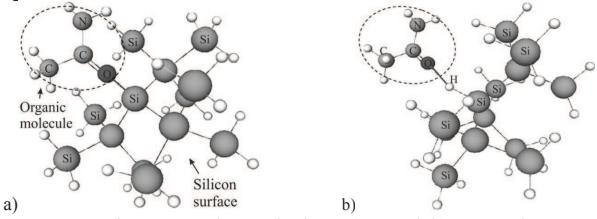
For theoretical investigation of the interactions mechanism B. subtilis with porous silicon, the structure of the cell wall of Gram-positive bacteria, consisting mainly of murein chains, is considered. Chemically active fragments was determined given the orientation of the biomolecules to the substrate. Special attention evokes the presence of oxygen in these fragments having a double bond to the carbon. Because a $\pi$-bond is weaker then $\sigma$-bond, it may take part in the interaction with the substrate. In this case, we can assume the presence of the following most probable formation mechanisms of a new bond between oxygen and substrate: direct interaction of oxygen with silicon (C-O-Si); interaction of oxygen with hydrogen bonded to silicon substrate (C-O-H-Si) (Fig. 1). Important to note that in the second case the hydrogen bond formation is possible.
To carry out quantum mechanical modeling using SCF (self-consistent field theory) was applied the program NWChem, which operates within the graphical environment ECCE. For atoms directly interacting in the reaction was used the basis 6-31G*, for the rest - 3-21G.
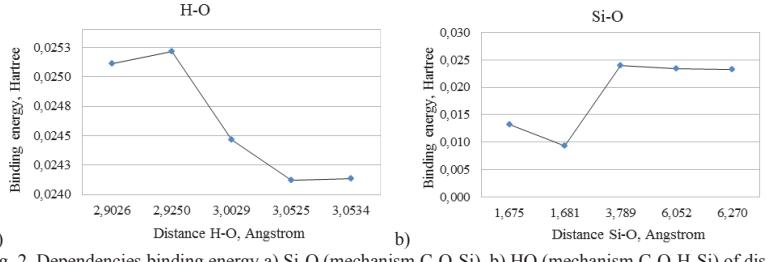
Simulation results showed that in the case of directly interaction between the substrate and molecule minimum of the binding energy is observed when the distance between them is about 0.168 nm (Fig. 2, a). This means that in this case bond formation takes place. In the case of interaction through hydrogen atom, the interaction energy decreases when the distance between the molecules increases. (Fig. 2, b). This means that interaction mechanism C-O-H-Si does not lead to formation of any covalent or hydrogen bonds. Thus, these results allow the conclusion that the bacterium is immobilized by the formation of chemical bonds on the silicon substrate, provided that the surface of the substrate free from hydrogen.