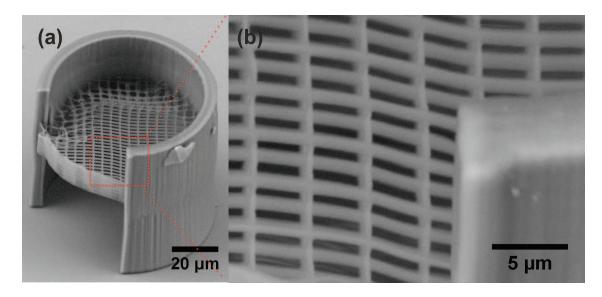
Many works during recent decade were dedicated to prove that polymers as suitable materials for three-dimensional (3D) micro- and nano-structure fabrication. Easy synthesis of polymers allows to chose material best suited for particular structure fabrication and its optimal performance. Cross-linking reaction can be induced by selectively introducing heat or light which allows relatively easy fabrication process. In case of light induced polymerization, most of the materials are photosensitized before exposing them to the irradiation. This is done to enhance their sensitivity to specific light wavelength and thus making fabrication process easier. Photosensitizing is done by doping polymers with 0.1-5 % w.t. photoinitiators [1]. Although these materials increase the photopolymerization reaction efficiency, there is some additional effects associated with photosensitizing, such as increased light absorption [1] and cytotoxicity [2]. This makes polymers doped with photoinitiators not perfectly suited for some researcher areas such as microoptics or biomedicine.
Recent works [3, 4, 5] showed that one way to avoid this problem is to induce polymerization reaction by tightly focused femtosecond laser beam, or, in other words, using Direct Laser Writing (DLW) technique [6]. In this case, because of very high intensity in focal point ($\sim$TW/cm2), nonlinear effects start to occur. It was experimentally demonstrated to be nonlinear absorption and subsequent avalanche ionization which induces bond braking [5]. This way radical polymerization reaction occurs even in non-photosensitized materials which in turn allows true 3D fabrication in micro- and nano-scale with spatial resolution up of hundreds of nanometers [6].
However, although possibility to cross-link polymers using DLW without photoinitiators was already demonstrated, further works have to be done to compare spatial resolution and structures formed out of pure and photosensitized polymers. Also, possibility to fabricate structures with different focusing conditions used to fabricate various kinds of structures have to be investigated. This work addresses these issues. As an additional result, method of using different focusing conditions to form one structure to improve fabrication throughput is proposed and tested. All structures in this work are formed from organic-inorganic polymer SZ2080.