There has been a growing interest in the study of room temperature ionic liquid (IL) – water mixtures, because the presence of a small amount of water can affect the ionic liquid dynamics [1, 2]. Raman spectroscopy has been used to observe the duration, until hydrogen/deuterium (H/D) exchanges, and the effect of deuterated water on the conformational equilibrium between the gauche and trans conformers on 1-butyl-3-methylimidazolium ([bmim]) cation in mixtures of heavy water (concentration $X_{\text{M}}$=0.01 mol). The preparation time of mixtures by the addition of room temperature D2O to the IL (liquid or solid aggregate state) in the sample cell was from 3 to 6 minutes. Raman spectra were measured at room temperature (295 K) by the Raman spectrometer. The 514.5-nm emission line from Ar+ ion laser was used as an excitation source with an average power of 200 mW and the resolution of 1 cm-1. There were several ionic liquids used for studies: [bmim][X], where X= Cl, Br, BF4, CF3SO3.
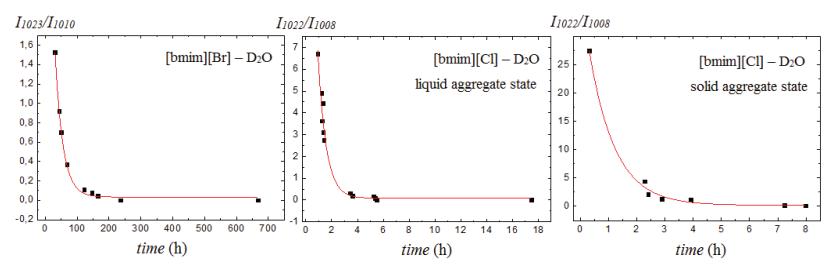
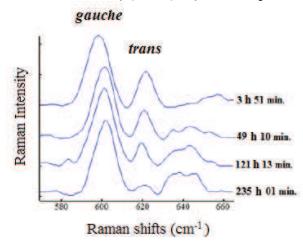
H/D exchange was determined by observing the intensity changes of vibrational bands in 980-1040 cm-1 wavenumber region. The duration of hydrogen/deuterium exchange, when all ILs were in the liquid aggregate states, in the case of [bmim][Br] – D2O mixture was $\tau^{\text{Br}} = (39 \pm 2.5)$ hours and for [bmim][Cl] – D2O mixture – $\tau^{\text{Cl}} = (122 \pm 20)$ min. In the case of [bmim][BF4] – D2O and [bmim][CF3SO3] – D2O mixtures H/D exchange does not occur. The duration was much longer in the case of [bmim][Cl] – D2O mixture was $\tau^{\text{Cl}} = (253 \pm 20)$ min when the IL was in the solid aggregate state. Vibrational band with a lower frequency is denoted as a C2-D vibration and the band with a higher frequency – C2-H. Time evolutions of the bands intensity ratio are shown in Fig.1. We suspect that H/D exchange duration depends on the purification of the sample and aggregation state of IL, it requires further investigations. Intensity changes of vibrational bands at 602 cm-1 and 620 cm-1 attributed to gauche and trans conformers respectively in the case of [bmim][Br] – D2O mixture (fig 2). H/D exchange induced the increase in a gauche conformer of [bmim] cation in the D2O mixtures [1].