Search and study of materials for lighting and display technologies attracts a lot of attention during the recent decades. (In,Ga)N is one among those that allow achieving a high efficiency of visible and UV range optoelectronic devices that currently are in huge demand. Understanding of recombination and transport of non-equilibrium carriers in such materials is crucial in order to obtain a clear view of non-radiative losses, occurring in light emitting diodes (LEDs) at high carrier densities. Such a monitoring of excess carriers can be achieved by optical pump-probe methods, which are non-destructive, do not require any special preparations of the samples, and most important- they allow measurements at high carrier densities, i.e. at conditions close to the operation point of a high power device.
In this work, five (In,Ga)N samples with same multilayered LED structures, but with differing In concentrations in quantum wells are investigated. The methods used are photoluminescence (PL) and light-induced transient gratings (LITG). In the latter experiment samples are excited selectively by using the optical parametric amplifier (OPA). The compared samples consist of 4 periods of GaN barriers and InxGax-1N QWs, where x varies from 0,15 to 0,32. All measurements are carried out at room temperature (T=300 K).
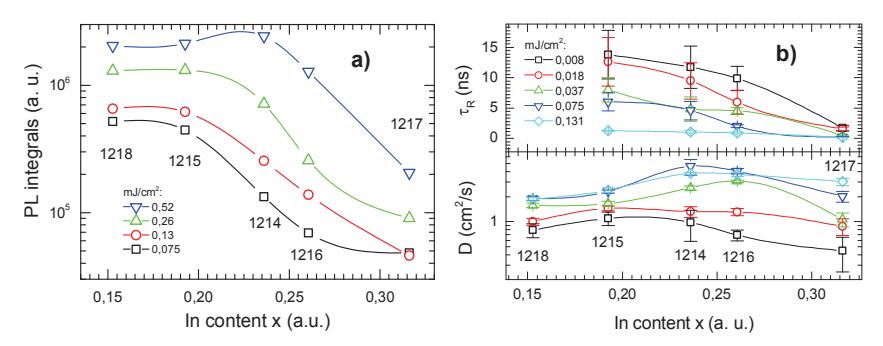
The results show, that photoluminescence intensity decreases with In content in QWs, as shown in figure 1 (a). LITG kinetics show shorter effective carrier lifetimes in samples with higher x, which may be attributed to more rapid non-radiative and/or radiative recombination, while diffusion coefficient at low pump intensities (up to 0.018 mJ/cm2) also drops (figure 1 (b)). These facts suggest that by introducing higher indium concentrations, the electric properties of the samples deteriorate, as the densities of recombination, localization and scattering centers grow. However, at higher pump intensities, diffusivity acts in the opposite way (figure 1 (b)).
All specimens show rise in diffusion coefficient with increasing excitation, which is most likely due to the filling of the localization centers, whereas shortening of the excess carrier lifetimes is attributed to density activated non-radiative recombination [1].
Simple modeling with non-equilibrium carrier lifetimes demonstrates, that increase in both non-radiative and radiative recombination rates is feasible with higher In content.