GaN and its derivatives are very important for their wide range of applications in modern optoelectronics. Although there has been a rapid progress in the development of these devices during the last decades, the details of the radiative and nonradiative recombination processes are not well understood. Instead, as a popular tool, simple nonequilibrium electron density rate equation is widely used to separate different recombination channels by their respective carrier density dependence.
The aim of this research was to model the carrier recombination mechanisms in GaN and to investigate the influence of equilibrium carrier densities on carrier dynamics. All the samples studied were grown on c-plane sapphire substrate using Metal-Organic Chemical Vapor Deposition. A number of GaN epitaxial layers with different equilibrium carrier densities ranging from 2.8·1016 cm-3 to 1·1018 cm-3 were selected for the study and grouped according to their equilibrium carrier density and carrier lifetimes into six series.
The PL study in this work has been performed under quasi-steady-state excitation. PL spectra at different excitation power densities were measured, and the PL spectral parameters were compared between and within the series. All the measurements were performed at room temperature.
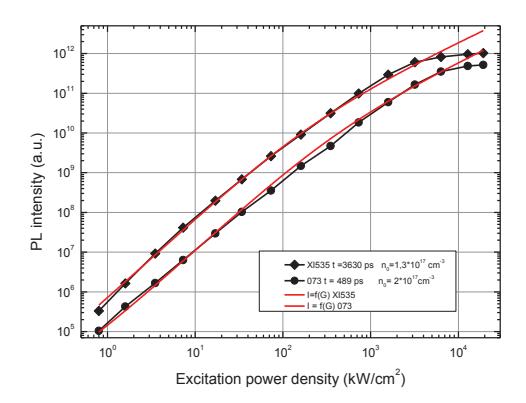
Experimental results were approximated using luminescence intensity dependence on the equilibrium and nonequilibrium electron densities
$$I_{\text{LUM}} \propto B \cdot \Delta n(n_0 + \Delta n),$$where B is coefficient of bimolecular recombination, $n_0$ – equilibrium electron density, $\Delta n$ – nonequilibrium electron density.
The carrier dynamics is studied using solution of the rate equations with equilibrium carrier densities taken into account. The results show that in samples with similar carrier lifetime, the deviation from the quadratic dependence of the PL intensity on excitation power density appears at lower excitation intensities in samples containing larger equilibrium carrier density. The influence of carrier lifetime on the quadratic dependence was found to be negligible.
The droop effect was observed in all the samples. It was found that, the samples with higher carrier lifetimes reached the onset of the droop effect at lower excitation intensities, as expected due to a higher carrier density at a fixed photogeneration rate.