Future of low-cost and easy processing optoelectronics is expected to be organic semiconductors which promise flexible devices and large area applications from solutions. The most widely used organic small molecule p-type semiconductors exhibit excellent hole-transporting properties although the morphological stability of amorphous films often is poor because of low glass transition temperatures. For this reason organic semiconductor materials are required to be suitable for forming amorphous films with high thermal and morphological stability possessing good hole-transport, mechanical and electrochemical properties.
To comply with all the requirements, effective hole-transport materials based on indolo[3,2-b]carbazole are investigated. These materials have nitrogen atom in the carbazole fragment which provides electron-donating ability. Moreover because of high glass transitions temperatures, indolo[3,2-b]carbazole compounds provide great thermal and morphological constancy. These advantages make indolo[3,2-b]carbazole compounds promising as excellent hole transport layers in OLEDs [1, 2].
In our work, we present investigation of six newly synthesised indolo[3,2-b]carbazole molecules, which differ in connected functional group. The optical and electrical properties of these derivatives as hole-transporting materials for blue light emitting diodes are reported. The aim of this work was to reveal fluorescence changes in mentioned materials caused by electric field and ascertain differences among all studied compounds determined by connected functional group.
Compounds were investigated as solutions using chloroform solvent and as thin films by using steady-state and ultrafast time-resolved spectroscopy. Films were made few hundred nanometres thick by spin coating technique.
Large influence of oxygen and evaporated aluminium electrodes to fluorescence quenching was observed. For SV100, SV101 and SV106 compounds impact of oxygen to fluorescence quenching was stronger than for M47, M60 and M66. Connected functional groups have more influence for shape of absorption spectra compared to almost not influenced fluorescence spectra of materials.
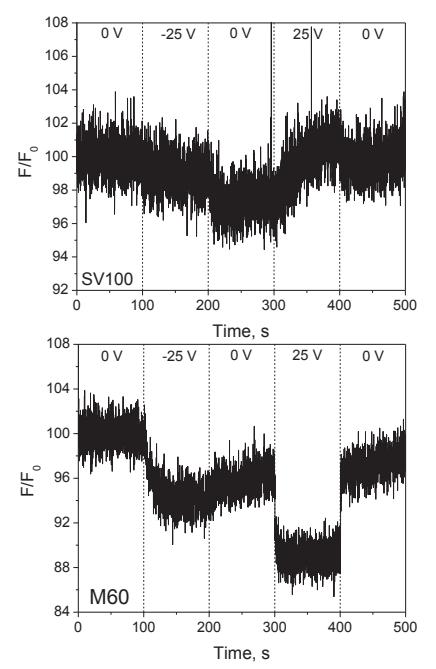
Fluorescence changes due to applied electric field are depicted in Fig. 1. Fluorescence of SV101 showed no dependence of added electric field. In SV106 compound fluorescence changes very weakly, also fast degradation was observed for this material. In SV100 electric field induced fluorescence changes are most noticeable. However, in M materials electric field influence to fluorescence is stronger than in SV materials, due to specific connected functional groups.