In this work, second harmonic (SH) generated from incoherent conical beams, consisting of multiple Gaussian-Schell (GS) [1] model beams is investigated. Theoretical description of the incoherent conical beam is provided. It is demonstrated that in the case of non-collinear phase matching spectrum of the second harmonic beam narrows with the propagation in a nonlinear crystal. An experimental result of a simplified case with 2 intersecting GS model beams is also presented. Numerical simulation results are in good agreement with the theory.
We assumed two fundamental conical beams. Each fundamental beam was constructed from N intersecting beams which spectra lie on the ring. The beams were assumed to be of Gaussian statistics, homogeneous, uncorrelated and their correlation functions were Gaussian. It was found that the spectral intensity in this case is described by the formula
$$G(\beta,\theta) = N b_0^2 \frac{2\sqrt{\pi}}{\Delta \beta \beta_0} \exp\left[\frac{-(\beta^2 - \beta_0^2)}{\Delta \beta^2}\right]\tag{1}$$where $β$ is the spectral radius, $θ$ is the azimuthal angle, N is the number of beams, $b_0$ is the amplitude of a single beam, $β_0$ corresponds to the cone angle and $Δβ = 2/ρ$, where $ρ$ is the radius of the Gaussian autocorrelation function. The spectral intensity of the first beam is described by the Eq. (1) and the spectral intensity of the second beam was obtained from Eq. (1), by letting $Δβ → 0$. It means that the second beam was assumed to be radially coherent.
Theoretical analysis of the SH generation was carried out. Analysis, carried out using the nonlinear interaction equations, suggests that when pump is not depleted, the spectral radiance can be expressed as:
$$\frac{G_3(0,0)}{G_{10}(\beta_0,0)} = 4N\frac{z^2}{L_n^2}\tag{2}$$where $L_n=1/(σb_0)$ is the nonlinear length and is $σ$ the nonlinear interaction coefficient. As can be seen from Eq. (2), the spectral radiance increases quadratically with crystal length z.
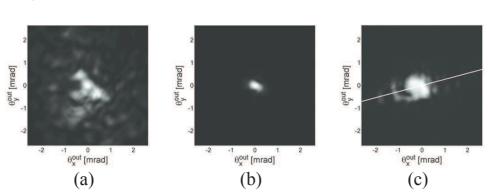
The experiment was carried out using only two intersecting beams: one coherent and one incoherent. The incoherent beam was obtained by using a phase distortion filter. The SH was generated from these two beams and recorded with a CCD camera. The results are shown in Fig. 1.
At large z, the SH beam has maximum at
$$β_x = -β_y β_0 I(k_0 γ)\tag{3}$$as indicated in Fig. 1 (c) by the white diagonal line. In Eq. (3) $k_0$ is the wave number and $γ$ is the walk-off angle. We note, that the direction of the line can be varied by changing the intersection plane of the pump beams. The results show good agreement with the theoretical calculations. The theoretically calculated spectral radiance in this case is the same as in Eq. (2) with N=1.
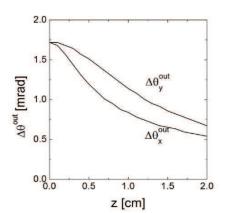
In the case of conical beams the interaction plane is undefined and the spectrum of the SH beam has a narrow central spot. This was confirmed by the numerical simulations of nonlinear coupling equations. From Fig. 2 we can see how the spectral width of SH beam narrows during the propagation in a nonlinear crystal.
In conclusion, we have demonstrated the possibility to improve the coherence in the two-dimensional case. The spatial walk-off would provide the improvement only in one direction [2], however, when conical beams are used, the spectrum of the generated SH beam has a central spot, which narrows down with propagation distance.