
Nuclear magnetic resonance spectroscopy (NMR) is a widely used method which provides detailed information about the chemical bonding, molecular structure and dynamics. NMR spectroscopy is widely applied to study proteins and nucleic acids. Oxygen is a common chemical element in nature, however, 17O NMR spectroscopy is rarely applied because this isotope has very low natural abundance. It was observed that using density functional theory (DFT) and dielectric continuum (DC) methods, the 17O NMR shielding constant is sensitive to both the structure of the peptide [1] and interactions with the aqueous environment [2]. The 17O NMR shielding constant of alanine dipeptide (Fig. 1) is potentially a appropriate probe of its structure and intermolecular interactions.
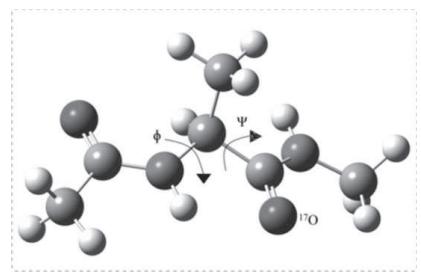
In this work, the NMR parameters of alanine dipeptide were investigate by means of quantum chemical methods. The alanine dipeptide has been extensively used to study the structure of proteins. The main reason resides in the fact that alanine dipeptide is able to model almost all known aminoacid conformations commonly found in proteins. Conformers of the alanine dipeptide are fully characterized by the Ramanchandran angles $\phi$ and $\Psi$ [3]. Nine conformers were modeled in vacuum and aqueous solution.
Another important NMR parameter of the alanine dipeptide is the 3J(H($\alpha$)-HN) spin-spin coupling constant which can provide information about the molecular geometry. Our modeling shows that the spin-spin coupling constant is not sensitive to the solvent, yet this constant is sensitive to conformation of the structure.
We have also applied the combined quantum mechanics/molecular mechanics (QM/MM) methods to calculate the NMR observables. In these calculations, the hydrogen bonding between alanine dipeptide and water molecules has been treated explicitly. The 17O NMR shielding constant varies slightly due to influence of the solvent for the three most stable conformers PPII, $\alpha$(R) and C5 in aqueous solution. We have conclude that 17O NMR conformational analysis is not suitable for alanine dipeptide, however, it can be expected that 17O NMR can provide important information about the protein structure.