
Prostate cancer is one of the most common cancer types in male population. Tumor genesis and progression in prostate is influenced by multiple genetic or epigenetic changes. Altered cellular epigenetic balance determines if cells become malignant and promotes the development of cancer [1].
Recent research on the human genome revealed big abundance of long non-coding RNA and its importance in the regulation of gene expression. H19 gene expresses a long non-coding RNA and functions as a tumor suppressor. It is located in an imprinted 11p15 locus near the insulin-like growth factor 2 (IGF2) gene and its promoter contains differentially methylated region (DMR), which is responsible for establishing paternal allele-specific methylation [2]. Epigenetic alterations in DMR sequences of H19/IGF2 gene cluster lead to the malignant diseases, such as Wilms tumor, bladder, cervix, prostate carcinomas and other types of cancer [3].
Prostate-specific antigen (PSA) test application is used in early detection of the disease, but it has low precision for prostate cancer, therefore the bigger part of the patients are misdiagnosed. It is vital to find a reliable molecular markers that are able to accurately distinguish cancerous alterations and identify early stages of the disease.
The main goal of our investigation was to evaluate appropriateness of H19 as epigenetic marker for prostate cancer detection. In this work we analyzed H19/IGF2 DMR methylation status in 54 samples of prostate carcinoma, compared them to 6 benign tissues and evaluated relations with clinical and demographic data.
DNA was extracted from tissues using phenol - chloroform method, then it was modified by bisulfite and amplified using methylation - sensitive PCR (MSP) method. Products of MSP reaction were analyzed on polyacrylamide and agarose gels after vertical and horizontal electrophoresis (Fig. 1).
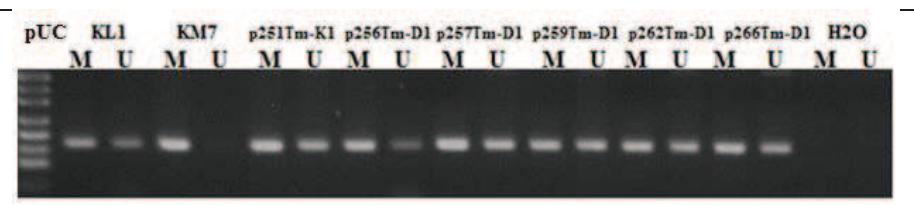
The results of MSP reactions showed 4 cases with hypermethylated DMR sequences. In all hypermethylation cases we observed second pT stage and Gleason score of 6 to 7. According to the data of progressive nature of tumor, 3 out of 4 cases were non-progressive tumors. We estimated the average age of patients with prostate carcinoma was about $65 \pm 5.29$ years and mean of PSA diagnostic concentration was $7.75 \pm 3.6$ ng/ml. Final examination revealed no significant correlation between the H19 promoter methylation status and patient age or clinical parameters.