
Malonaldehyde molecule is a toughie for experimental methods for determining the frequency of the stretching vibrations of the hydroxyl group involved in the formation of an intramolecular hydrogen bond. That is why the theoretical methods of investigations are very important in this case.
We have found the equilibrium geometry and calculated IR spectra of this molecule using B3LYP/cc-pVDZ, B3LYP/cc-pVTZ and B3LYP/cc-pVQZ approximations. In all cases IR spectra were calculated in harmonic and unharmonic approach. It was found that there is strong interaction between stretching O-H bond and one of C-H bond vibrations. Due to this fact the harmonic wavenumber for $\tilde{V}_{OH}$ is 3118.2 cm-1. In potential energy distribution (PED) of this mode there are two terms - 71.0% $q_{OH}$ + 26.6% $q_{CH}$. On the other hand harmonic wavenumber for $\tilde{V}_{CH}$ is 3174.0 cm-1. As kinematic interaction between this internal coordinates is absent we have to assume that there is force interaction in this case. Really, we have found that off-diagonal force constant, describing this interaction was found to be -0.066 mdyn/Å. In PED of this mode there are two terms too - 26.3% $q_{OH}$ + 70.1% $q_{CH}$. To find the harmonic wavenumber for $\tilde{V}_{OH}$ without force interaction we slightly changed Hessian removing interaction between hydroxyl and C-H hydrogen atoms. This decreased off-diagonal force constant $k_{OH/CH}$ up to 0.003 mdyn/Å. So unperturbed wavenumber and PED of $\tilde{V}_{OH}$ are 3130.8 cm-1 and 97.4% $q_{OH}$ + 0.2% $q_{CH}$ So, one can see that interaction between stretching O-H bond and one of C-H bond vibrations leads to red shift of $\tilde{V}_{OH}$.
Using B3LYP/cc-pVQZ approximations 1D and 2D potential energy surfaces were calculated (Fig. 1).
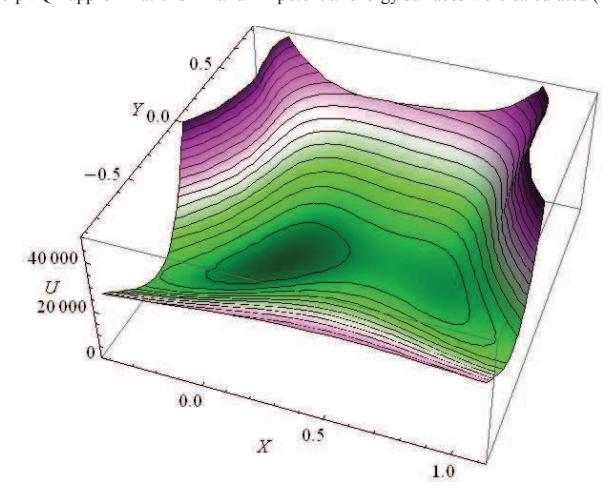
We were able to calculate wavenumbers of O-H group vibrations using PES by numerical solving of the Schrödinger equation. They were compared with results of unharmonic calculations of malonaldehyde IR spectra in the same approximation.