
Among numerous methods of analysis of biologically active substances [1], immunosorbent immune assay (ELISA) prevails as it allows one to avoid the drawbacks of traditional chromatographic methods [2]. However, the synthesis of reagents needed for ELISA of low-molecular weight is often accompanied by difficulties caused by the structure of the defined hapten.
ELISA-based test systems are the most popular methods for analysis of antibiotics and, in particular, tetracycline group. Antibodies against tetracyclines can only be obtained by animal immunization with macromolecular immunogens, which are mainly covalent conjugates of haptens with carrier proteins. The structure of immunogens in terms of binding site, length, rigidity, hydrophility, and steric configuration of the linker group is the critical factor for obtaining high avidity antibody.
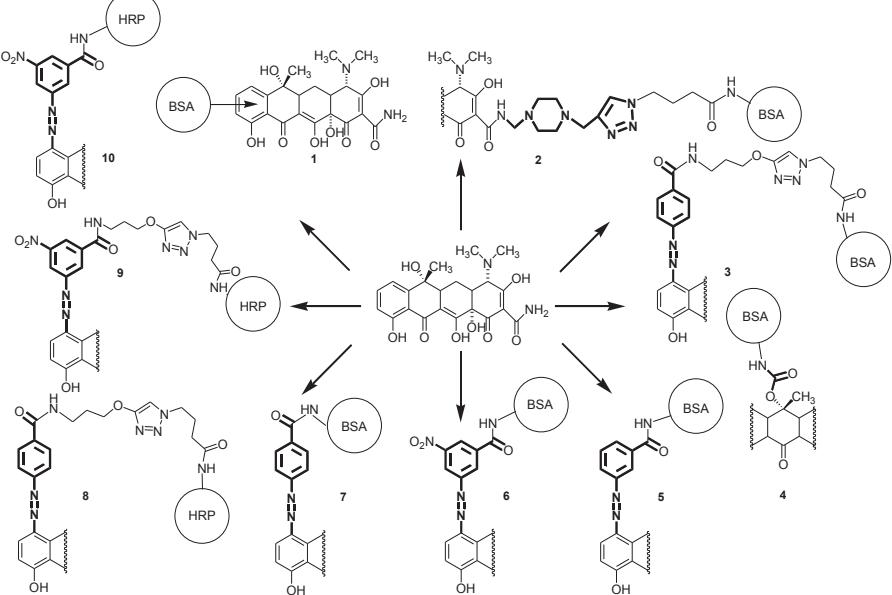
We have developed several schemes of directed modification of the tetracycline molecule and obtained conjugates with bovine serum albumin (BSA). In order to improve the specificity and to exclude the effect of the linker and the carrier protein on the antibody, a range of immunogens with different structures has been synthesized. Modification was carried out via the amide group (2), the aromatic ring (3, 5, 6, 7), the hydroxyl group (4), and random multiple modification (1) via linkers of different structures and lengths (Fig. 1).
Balb/C mice have been immunized with the immunogens described before. According to the results of ELISA, plasma of the immunized mice contained antibodies that specifically interact with different conjugates of tetracycline and do not cross-react with the carrier protein.
Besides, tetracycline - horseradish peroxidase (HRP) conjugates have also been synthesized. The modification has been carried out via the aromatic ring (8, 9, 10).
The methods developed allow one to obtain a range of tetracycline conjugates of desired structures.