
It is expected the formation of defect when high-energy Si knock-on atoms are created and cluster effects are likely to be quite important for radiation damage of silicon detectors in LHC experiments. However, the understanding of these effects in Si detectors erradiated with different particles is insufficient as compared to the knowledge on the role of isolated point defects.
DLTS is one of the main methods of defect characterization in semiconductor structures. At present two characteristic features of clustered defects are well established. First, it is temeperature dependence of DLTS peak amplitude $S_{\text{max}}(T)$ and closely related to this feature the inequivalent heights of divacancy peaks [1 – 3]. And second, the stretched kinetics for filling of clustered traps [3, 4]. This work focuses on studies of the first effect. Numerical simulation of cluster effect on DLTS signal has been performed.
To calculate temperature dependence of any DLTS peak related to a defect in a cluster it is necessary to calculate the distribution of electric potential and then to determine occupancy number of defects. To obtain electric potential $\psi$ for the distribution of defects with axial symmetry the following problem should be solved:
$$ \frac{1}{\rho} \frac{\partial}{\partial \rho} \left( \rho \frac{\partial \psi}{\partial \rho} \right) + \frac{\partial^2 \psi}{\partial z^2} = -\frac{\rho_c(\rho, z, \psi)}{\varepsilon \varepsilon_0}, \quad \rho > 0, -\infty < z < +\infty, \tag{1} $$$$ \frac{\partial \psi}{\partial \rho}\Big|_{\rho=0} = 0, \quad \psi \xrightarrow[\rho \to \infty]{} 0, \quad \psi \xrightarrow[|z| \to \infty]{} 0, \tag{2} $$where charge density $\rho_c$ is given by
$$ \rho_{c}(\rho, z, \psi) = e(N_{d} - n(\psi) - N_{VV}(\rho, z) f_{VV}(\psi)), \quad \tag{3} $$carrier concentration n is related to electrical potential
as $n(\psi) = N_d \exp\left(\frac{e\psi}{k_B T}\right)$, fVV is average charge of divacancies. The distribution of defects in a cluster (NVV) is characterized by the following function:
$$ N_{VV}(\rho, z) = \frac{M_{VV}}{\sqrt{\pi^3} b a^2} \exp\left(-\frac{\rho^2}{a^2} - \frac{z^2}{b^2}\right),\tag{4} $$where MVV is number of divacancies in a cluster, $a = R\gamma^{-1/3}$, $b = R\gamma^{2/3}$, ($\gamma >1$), hence, the cluster has the same characteristic volume as a spherical cluster with characteristic radius R.
The problem (1) - (2) was solved using finite element method. The results of the simulation were compared with experimental data obtained by DLTS method in order to identify unknown parameters of the cluster, particularly, number of divacancies in cluster. Fig. 1 represents this comparison for doubly charged divacancies.
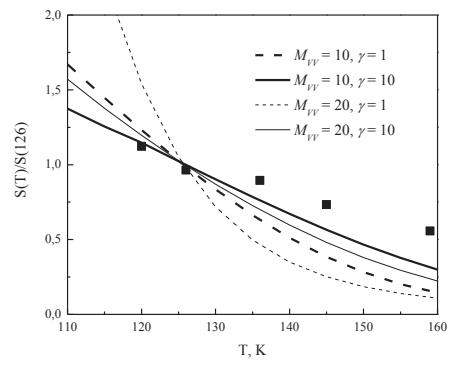
As shown in Fig.1, peak amplitude demonstrates stronger dependence on temperature with increasing MVV and decreasing $\gamma$. Since the value of MVV, required to fit experimental data, is fewer than expected number of divacancies in a cluster, prolate clusters show better agreement with experimental data than spherical clusters.
We also considered clusters with distribution of defects characterized by sum of two functions of the kind (4) with different values of a and b and combinations of two close clusters.