
Since the first researches of semiconductors their unique light conversion property was observed which can be used for electromagnetic waves conversion to electric current and vice versa. Efficiency of this process is determined not only by light absorption or escape, but also by electric and thermal semiconductor properties. Most important of them are charge localization or separation realized in modern semiconductors with heterojunctions or thin layers. Series resistance also plays significant role in decreasing overall efficiency and increasing crystal temperature. Non-radiative recombination also increases crystal temperature which also have positive feedback.
Light-emitting diodes stands out with its relatively long life time, although catastrophic degradation is not intrinsic like of other luminaires. Degradation of LEDs is observed with light output gradual declination [1]. Defect generation in active or cladding layers, degradation of contacts and lens resin are responsible for light output variations [2].
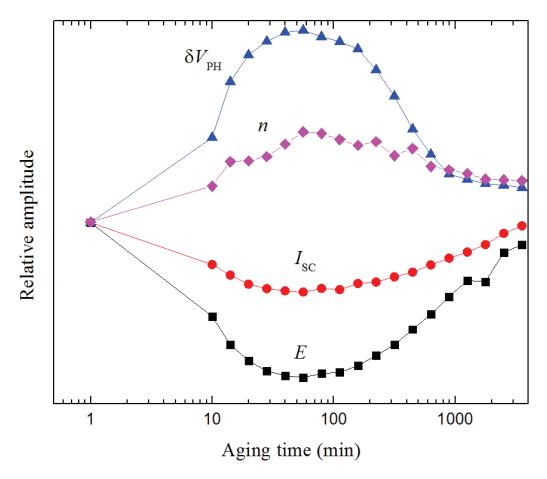
The goal of this study was to prepare necessary equipment and methodology for electrical and optical parameters characterization of light-emitting diodes as function of aging duration. The mount was designed and custom made withstanding constant experimental condition and stabilized temperature for all devices under test. Automated LED aging current source with integrated stopwatch was made to ensure precise aging time constants. Methodology and automated operation of electrical and optical parameters characterization experiments was developed. Electrical parameters characterization consists of current-voltage, capacitance-voltage, differential photo-voltage versus current and short circuit current experiments. Optical parameters are investigated employing light-current experiment. Preliminary results (Figure 1) showed correlation between extreme point of differential photo-voltage, ideality factor, short circuit current and light flux as functions of aging time.