
Surface acoustic waves (SAW) are widely used in many electronic devices like fiters, converters, delay lines. SAW devices became popular when american scientists R. M.White and F.W. Volmer [1] suggested the interdigital trasducer (IDT) for SAW excitation and reception in piezoelectrical materials. Leaky surface acoustic waves (LSAW) are also popular for using in electronic devices. These waves has a shear horizontal polarization, which makes them especially interesting for sensor applications.
The objective of this research was to investigate the impact of surface metallization on the propagation of the LSAWs in piezoelectric 36° rot. Y-X LiTaO3 crystals. Two experimental methods, the acousto-optic technique and the electroacoustic technique, were used.
The leaky SAWs of the LiTaO3 crystals were generated using the interdigital transducers with a period of 50 μm and 33 electrode pairs.
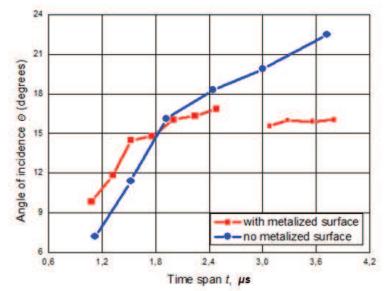
When using the acousto-optic method, the He-Ne laser beam was pointed onto the crystal surface. The leaky SAW generates a bulk acoustic wave. Both waves cause the diffraction of light. During the experiment, we searched the angle of incident light corresponding to the strongest intensity of the diffracted light. The experiment revealed that coating the surface of lithium tantalate with a strip of metal causes changes both in the amplitude of the diffracted light signal and in the amplitude of the signal detected with interdigital transducers. Also, we have noticed the changes in the light incidence angle due to metallization. As seen in Figure 1, after coating the surface of lithium tantalate with a copper strip of 1 millimeter width, the angle of incident light behind that strip does not change the turning beam of light away from the source of acoustic waves.
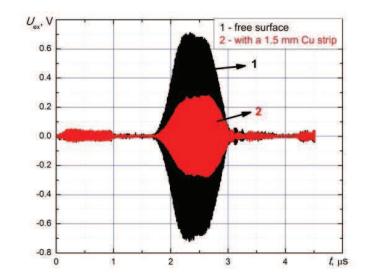
When using the electroacoustic method, the leaky SAW was generated and detected with the interdigital transducer. We have observed strong changes in the wave amplitude due to crystal surface metallization. An example of strong signal decrease when the crystal was coated with a 1.5 mm Cu strip is shown in Figure 2.