Five-membered rings have been of interest to structural physicist and chemist because they may have any one of the three different stable conformers, i.e., planar, twisted and envelope forms, or possibly more than one of these forms [1]. Also, when one of the CH2 groups in cyclopentane is replaced by a SiH2, GeH2, O, NH, etc., the potential barrier between the cyclopentane conformational forms is so small for some of these molecules that the ring motion can be described as pseudo rotation, which is nearly barrier-free for cyclopentane [2]. So, it is important to investigate structural parameters of substituted cyclic organic compounds.
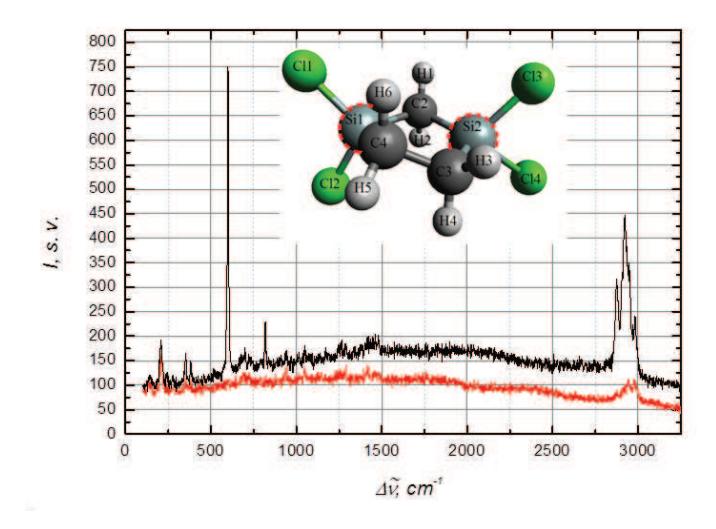
In this work the Raman spectrum and the polarized Raman spectrum (Fig. 1) of liquid 1,1,3,3-tetrachlor-1,3-disilacyclopentane have been recorded. Additionally, geometry optimization, Raman activities, depolarization ratios and scaled vibrational wavenumbers have been determined from ab initio calculations and compared with experimental values when available. It was determined that anharmonic calculations are more accurate then harmonic. Finally, the ring torsional angles in cyclopentane are increasing when Si or Ge substitutes are added. This difference causes the cyclopentane ring to be much 'flatter' than the disilacyclopentane ring.