Progress in the epitaxial growth technologies of SiC has expanded its application for power devices, such as high frequency power controllers and bipolar switching devices, which operate under high injection conditions. Therefore, in addition to the structural quality of the grown materials, appropriate attention must be paid to the peculiarities of recombination and transport processes at high nonequilibrium carrier densities.
In this work, we present a study of non-equilibrium carrier recombination and diffusion in various p-type SiC polytypes using differential transmittivity (DT) and light-induced transient gratings (LITG) techniques. Band to band generation was performed using third/fourth harmonics (${\lambda_{3,4}}$=351, 263 nm) of the picosecond Nd:YLF laser. In the LITG method, the decay of the transient grating was monitored by an optically delayed probe beam with the wavelenght ${\lambda}$=1053 nm (with ~ 13 ps resolution). In addition, slower nonequilibrium carrier dynamics was also monitored by electronically delayed probe beam (${\lambda}$=1064nm) with about 2 ns pulse duration.
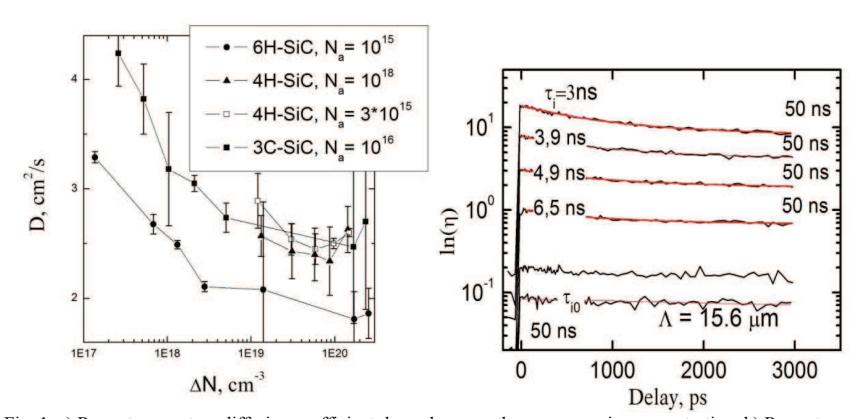
DT measurements by employing the electrical delay line showed that free carrier recombination time in 6H-SiC was ${\tau_R \approx 100}$ ns, which was the longest among the studied samples; free carrier lifetimes of about 50 ns were measured in the other samples.
DT kinetics in low-doped 4H-SiC epilayer showed dependence of decay of the fast component on the injected carriers, which can be described by a function ${\tau_R \propto \Delta N^{0.51}}$, implying the effects of carrier recombination at the surface. The data are compared with results of work which reported the similar while stronger dependence [1]. The measured injection dependence of the diffusion coefficient in 3C-SiC and 6H-SiC samples revealed a significant reduction of the diffusion coefficient with increasing excess carrier concentration, which is due to the band-gap narrowing (BGN) [2].