Eglė Bašinskaitė1, Jan Alster2, Vytautas Butkus1, 3, Darius Abramavičius1, Leonas Valkūnas1, 3, Donatas Zigmantas2
1 Department of Theoretical Physics, Faculty of Physics, Vilnius University, Vilnius, Lithuania
2 Department of Chemical Physics, Lund University, Lund, Sweden
3 Molecular Compounds Physics Laboratory, Center for Physical Sciences and Technology, Vilnius, Lithuania
2D Electronic Spectroscopy (2DES) is a state-of-the-art ultrafast optical spectroscopy technique, used to probe the dynamics in the system after excitation [1]. Direct mapping of excitation energy transfer in molecular systems enriched our knowledge about energy structure of many essential systems, for example, Photosynthetic reaction centers [2] and light harvesting complexes [3].
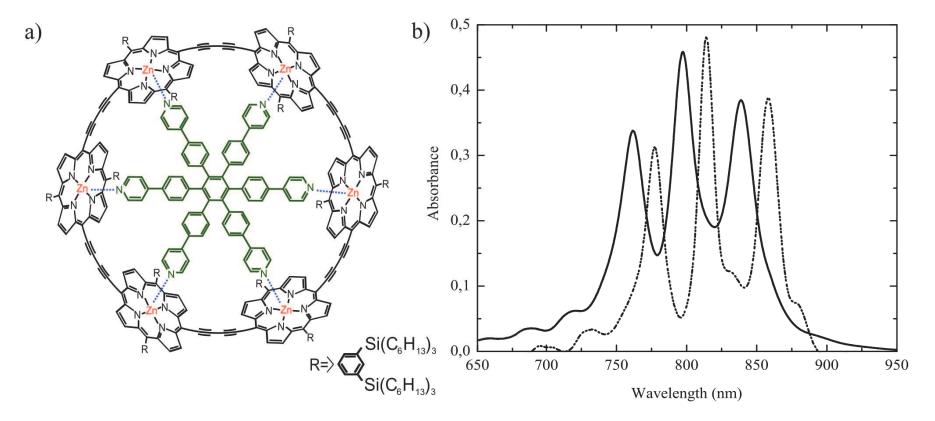
The cyclic porphyrin hexamer-template complex or porphyrin nanoring (PNR) is fully-conjugated belt-shaped system with different properties when compared with single porphyrins or linear porphyrin polymers. Large red-shift is present in absorption spectrum as well as appearance of three peaks structure in absorption bands (Fig. 1). Structural similarity with light harvesting complexes (particularly with LH2 [4]), encouraged scientists to synthesize and examine porphyrin polymers shaped in a cyclic manner [5,6].
In this study, analysis of energy transfer in PNR system using 2DES is presented. 2D spectra, measured in room (300K) and cryogenic (77K) temperature, revealed energy levels in the PNR complex, different compared with single porphyrin. Two different energy transfer rates were found between the levels – fast energy transfer to the lowest excited state with the lifetime of 200 fs, followed by a slower relaxation to the ground state with lifetime of 280 ps. The work is concluded by comparing experimental maps with those obtained from simulation.
Fig. 1. Structure of Porphyrin Nanoring (a) and corresponding linear absorption spectra at 300 K (solid line) and 77 K (dashed line) temperatures (b).
[1] S. Mukamel, Principles of Nonlinear Optical Spectroscopy (Oxford University Press, New York, 1995).
[2] S. Westenhoff et al., Coherent picosecond exciton dynamics in a photosynthetic reaction center, Journal of the American Chemical Society, 134(40), 16484-16487 (2012).
[3] T. Pullerits, D. Zigmantas, and V. Sundström, Beatings in electronic 2D spectroscopy suggest another role of vibrations in photosynthetic light harvesting, Proceedings of the National Academy of Sciences, 110(4), 1148-1149 (2013).
[4] G. McDermott, S. M. Prince et al., Crystal structure of an integral membrane light-harvesting complex from photosynthetic bacteria, Nature, 374(6522), 517-521 (1995).
[5] M. Hoffmann, C. J. Wilson et al., Template directed synthesis of a p-conjugated porphyrin nanoring, Angewandte Chemie International Edition, 46(17), 3122-3125 (2007).
[6] J. K. Sprafke, D. V. Kondratuk, et al., Belt-shaped $\\pi$-systems: Relating geometry to electronic structure in a six-porphyrin nanoring, Journal of the American Chemical Society, 133(43), 17262–17273 (2011).