
Stabilization of unstable steady states (fixed points) of dynamical systems is of great importance, especially in engineering applications to mechanical, electronic, optical, chemical, biological, etc. systems.
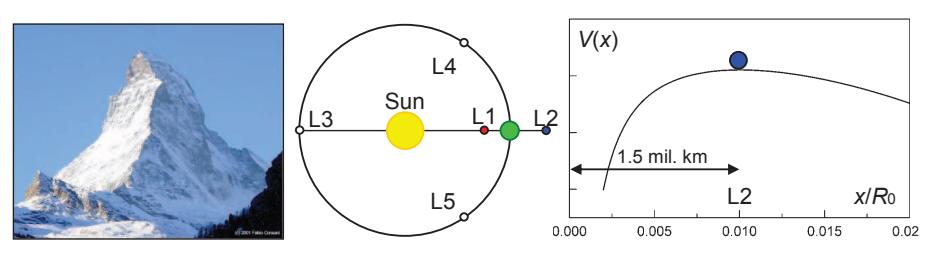
Dynamics of a system, described by a state variable $x(t)$, is given by the second order differential equation:
$$\frac{\mathrm{d}^2 x}{\mathrm{d}t^2} + b \frac{\mathrm{d}x}{\mathrm{d}t} + \frac{\mathrm{d}V(x)}{\mathrm{d}x} + \xi = 0, \tag{1}$$where $b$ is a friction (damping) coefficient, $\xi$ is an unknown (probably slowly varying) force or perturbation. In the vicinity of a fixed point, e.g. a peak of a mountain or the Lagrange point L2, the potential $V(x)$ can be approximated by a downward parabola $V(x) = -x^2/2$. Then Eq. (1) reads
$$\frac{\mathrm{d}^2 x}{\mathrm{d}t^2} + b \frac{\mathrm{d}x}{\mathrm{d}t} - x + \xi = 0. \tag{2}$$The steady-state solution $[x_0, dx/dt]$ is simply $[\xi, 0]$. It is an unstable saddle type fixed point, characterized with an odd number of real positive eigenvalues. Moreover, its coordinate $x_0$ is uncertain because of an unknown $\xi$. To control unknown saddles Pyragas et al. [1] proposed an elegant feedback controller, employing an unstable (!) first order filter:
$$\frac{d^2x}{dt^2} + b\frac{dx}{dt} - x + \xi = k(u - x), \quad \frac{du}{dt} = \omega(u - x). \tag{3}$$The unstable filter method has been successfully applied to several physical, electrochemical and electronic systems [2, 3]. To stabilize a system the cut-off frequency of the filter $\omega$ in Eqs. (3) should be less, than the friction coefficient, $\omega < b$. This condition is difficult to meet for systems with low friction ($b << 1$), i.e. for "slippery" systems, and quite impossible to fulfill for conservative systems, e.g. the Lagrange points ($b = 0$) [4].
To get around the problem we suggest to supplement the controller with a common stable first order filter:
$$\frac{d^{2}x}{dt^{2}} + b\frac{dx}{dt} - x + \xi = k_{1}(u - x) + k_{2}(v - x), \quad \frac{du}{dt} = \omega_{1}(u - x), \quad \frac{dv}{dt} = \omega_{2}(x - v). \tag{4}$$Here the cut-off frequencies $\omega_1$ and $\omega_2$ are not limited by $b$ (friction can be very small or even zero). We note, that alone neither the unstable filter (in the case of $b = 0$), nor the stable filter (for any $b$) can stabilize a saddle steady state. Therefore, the control technique, given by Eqs. (4), can be considered as an extremely efficient synergetic method.
Very recently, two alternative methods [5,6], including a simpler, but more effective technique, using derivatives of both, variable $u(t)$ and variable $x(t)$ [6], instead of the difference term $k_2(v-x)$ in the feedback, have been described.