
As quantity of information being stored worldwide nearly doubles every three years, new and more efficient storing methods needs to be developed. To deal with ever growing demand for storage space, perpendicular recording devices has been proposed. One of the most promising materials for perpendicular magnetic devices could be — implemented iron nano-wires into highly ordered porous anodic alumina oxide template. Such nano-wires could be magnetized either up or down representing logical 0 or 1.
Producing highly ordered magnetic nano-wires, however, proves to be somewhat but easy task. The main problem encountered — that iron nano-wires do not behave as bulk iron material, as a consequence of that do not form ferromagnetic compounds. Determining conditions under which anodic aluminum oxide (AAO) templates implemented with iron nano-wires can be produced with good ferromagnetic properties is important task.
Annealing alumina templates in air atmosphere at temperatures up to 600 °C result in formation of paramagnetic Fe(II) and Fe(III), most probably in a spinel FeAl2O4 [1]. Also, researches proved that under influence of atmospheric air iron nano-wires begin to oxidize and degrade [2] forming non-ferromagnetic compounds. Given these facts, this work was made to determine whether annealing AAO templates in vacuum and heating the samples in range of activation temperature 300-400 °C could increase the ferromagnetic properties of these templates.
Using Mossbauer spectrometer, I investigated effects on AAO templates of different heating speed, maximum temperature and cooling speed of for the. All investigated samples displayed highly anisotropic magnetic properties. Typical Moesbauer spectrum is shown in Fig. 1
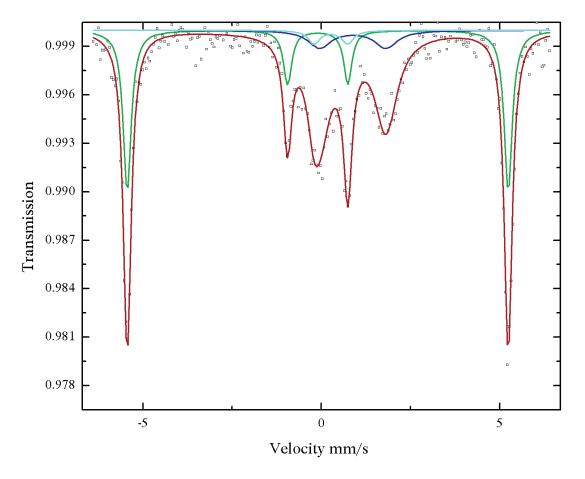
After investigation of spectra, ratios between different iron compounds has been calculated
$$W_i = \sum_n \frac{A_i}{A_j} \tag{1}$$After this research conclusions has been drawn that at higher annealing temperatures larger $\alpha$-ferrum dissipates into the alumina template producing larger ratios of Fe(II) and Fe(III) compounds. Also, I managed to disprove that the oxygen responsible for formation of $\alpha$-Fe (Fe1-xAlx)2O3; x=0,99; and FeAl2O4 compounds has an atmospheric origin.