
Organic compounds are becoming increasingly popular in the optoelectronics market. OLEDs, organic solar cells, organic semiconductor based sensors are already being made and used in practice. The usage of more complex molecules in these devices show the best results. Because of their efficiency anthracene and carbazole derivatives are a popular choice, therefore improving them is important. However, implementing any kind of new molecular systems first requires a detailed analysis of their photophysical properties.
Here a summary of optical, photoelectrical and quantum chemical properties of 10 new anthracene-carbazole derivatives (see Figure 1) with non-conjugated and conjugated substituents is presented.
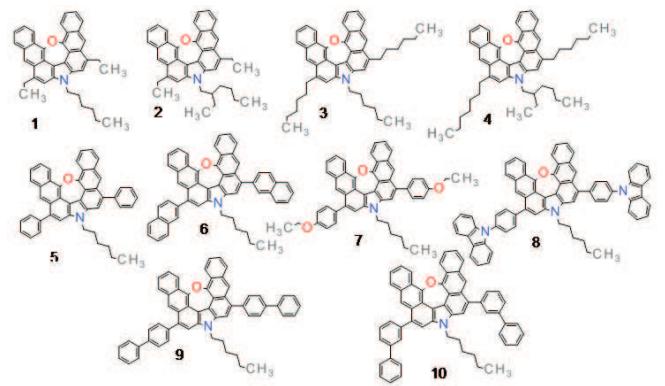
Quantum chemical calculations of charge density distribution of the highest-occupied (HOMO) and lowest-unoccupied (LUMO) molecular orbitals of two characteristic NOP derivatives with conjugated and non-conjugated substituents showed that charge density is distributed over the whole molecular backbone with a slight charge transfer character. The conjugation extends to the aryl substituents (compounds 5-10) resulting in the increase of the molecular dipolar momentum. The measured absorbance spectra resemble those that are typical to anthracene and carbazole derivatives, the first two peaks in the lower energy part corresponding to anthracene and the intense absorbtion band in the higher energy part is typically seen in carbazole derivatives. The emission spectra have a peak at ~540 nm and a vibronic structure when measured in toluene and are more wide-spread, formless and shifted to the lower energy part by ~20nm in DMF (dimethylformamide). This is a typical result for charge transfer fluorescence. A shift of 10 nm to the lower energy part and an almost doubled extinction coefficient is observed in the compounds with conjugated substitutes. The results show a poor quantum yield of the NOP compounds (~4%-12%), however it increases by 2-3 times when the conjugated substitutes are added. The fluorescence lifetimes are rather long (~9ns-12ns), increasing with added conjugated substitutes. The increase of the quantum yield is due to a higher rate of radiative recombination, which was induced by the increased oscillator strength after the conjugated substituents were introduced. Due to the reduced molecular interactions fluorescence concentration quenching effect was reduced up to 3 times when the bulky aryl moieties were added. NOP derivatives with alkyl groups showed very efficient crystallization and made the estimation of mobility impossible, whereas derivatives with bulky aryl substituents demonstrated high hole drift mobility up to 8·10-4 cm2/Vs. NOP derivatives 1-4 showed an ionization potential of about 4.72 eV which increased up to about 5.17-5.48 eV for derivatives 5-10. High hole mobility and tunable energy of HOMO and LUMO levels make NOP derivatives promising for the applications in OLEDs and organic solar cells.