The carbonic anhydrases (CA) are established as therapeutic targets. There are 12 catalytically active CA isozymes in human body. At least 30 CA sulfonamide inhibitors have been used as drugs to treat glaucoma, epileptic seizures, altitude sickness, and as diuretics [1]. However, most of them exhibit poor selectivity towards target isozymes and result in various side effects.
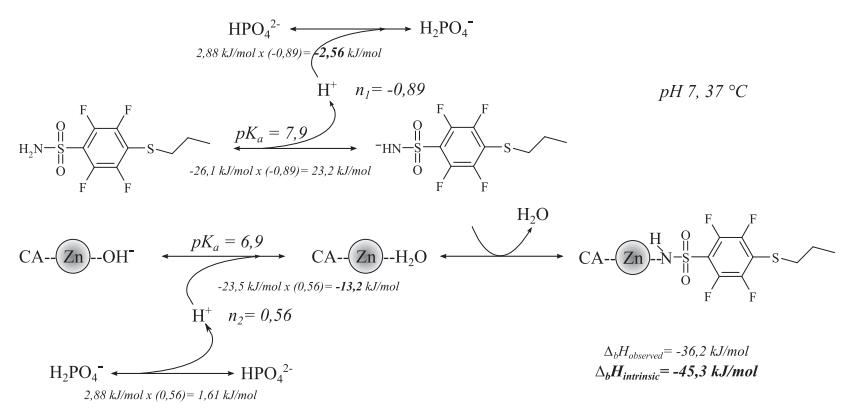
In this work, a class of 4-substituted-benzensulfonamides and 4-substituted-2,3,5,6-tetrafluorobenzensulfonamides as inhibitors of CA is reported. The binding affinity to carbonic anhydrases I, II, VII, XII and XIII was measured by isothermal titration calorimetry and thermal shift assay, and inhibition was determined by stopped-flow CO2 hydration assay. The combined use of these methods has provided a detailed picture of protein-ligand interactions. Experimentally obtained binding data usually depends on various factors including buffer and pH. In this study, intrinsic parameters of binding that are independent of these experimental conditions are presented. Structure–thermodynamics correlations were studied using intrinsic parameters. All used biophysical methods have confirmed that fluorinated sulfonamides bound stronger to CA than non-fluorinated, because the presence of electronegative substituents decrease the pKa of sulfonamide group and this correlates with an increase in the CA inhibitory properties [2]. Furthermore, fluorinated compounds possessed nanomolar affinity for selected CAs and were selective towards CAI. One of the studied compounds exhibited exceptionally high-affinity and was selective inhibitor of CAI.