Ferroelectric materials are of high interest for both researchers and engineers due to their remarkable properties. Their high dielectric permittivity allows us to make smaller capacitors and their switchable electric polarization can be used for memory storage. We should note that all ferroelectrics have piezoelectric properties [1] and can be used, for example, in piezoelectric motors [2]. In recent decades electronic devices tend to nanoscale, this brings the necessity to research ceramics grain size effects. Although ferroelectric PZT has taken almost all piezoelectric market due to its high piezoelectric coefficient [3], BSPT has ~ 100 K higher Curie temperatures than PZT, this allows making piezoelectric devices for higher temperatures.
In this presentation grain size effect on dielectric permittivity of xBiScO3-(1-x)PbTiO3 (BSPT) where x=0.375 ceramics will be presented. Usually dielectric permittivity in ceramics should decrease as its grains get smaller, since the effective volume of grain boundaries grow (grain boundaries has lower permittivity). Effective permittivity of ceramics can be approximated with coated shell model [4]:
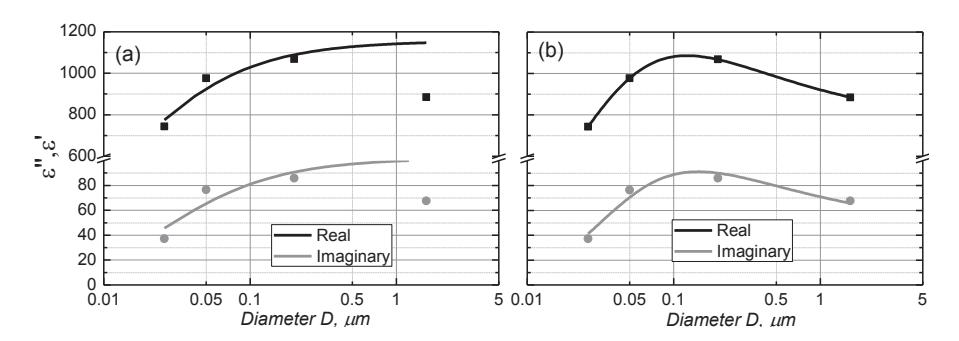
$$ \varepsilon = \varepsilon_2 \left( \frac{x - n}{1 - x} \right) + \left( \frac{1 - x}{1 - n} \right) \frac{\varepsilon_1 \varepsilon_2}{(1 - n)\varepsilon_2 + n\varepsilon_1},\tag{1} $$where $\varepsilon$, $\varepsilon_1$, $\varepsilon_2$ are complex dielectric permittivities of ceramics, grain core and grain shell respectively, x – grain shell volume and n – free parameter, characterizing the particle shape and topology. As we see in figure 1 (a) this model is accurate in low grain size region. The decrease of dielectric permittivity in high grain size region can be explained by Kittel's law which states that reducing crystallites size will decrease domain thickness, thus increasing wall count and in result dielectric permittivity (2). In figure 1 (b) coated shell model with Kittel's law correction fit curves correspond all experimental data.
$$ \varepsilon_1 = \varepsilon_{C0} + \frac{C}{\sqrt{D}},\tag{2} $$where C – constant, D – grain diameter $\varepsilon_{C0}$ – dielectric permittivity without domains.